Showing posts with label Leadership. Show all posts

Sunday, December 3, 2017

HUNGRY PEOPLE, BETTER RESULTS by Deepak Malhotra

HUNGRY PEOPLE, BETTER RESULTS - Unleash the Fire Within to Win Continually in Life by Deepak Malhotra (2017), Bloomsbury, p 298.

Leadership has been a key domain of discussion among academicians and practitioners in last one century starting with a belief on Leaders are born to Leaders can be made. Both the views had their merits and demerits and the literature has proved that one can learn the art of leadership and become successful leader if one is open to learning and has developed a positive attitude towards change.
This book by Deepak Malhotra tries to narrate the nuances of practicing leadership through the perspective of selected successful leaders in different areas of their work and profession. Though the individuals who have been selected for their views on leadership and their conception of Hungry People Better Results have proved excellent records yet the criterion of their selection has not been made explicit anywhere in the volume. It seems to be the prerogative and convenience of the author.  The efforts made by Deepak to gather together these many leaders is remarkable. Though the book looks like a lengthy volume, once you start reading and flip its pages, you can presumably find it handy, short and simple.  At times it gives you a feel that it is an extended version of Oxford book of quotations, but suddenly you find a narrative advice on the ways how one can succeed in life and career. The pathways are illustrative and many a times repetitive.

The book has as many as 29 chapters covering achievers and leaders who have strong messages for practice. It includes business luminaries like Kiran Mazumdar Shaw, Harsh Vardhan Goenka, Harsh Neotia, on one side and cricketers like Bishen Singh Bedi and Ravi Shastri on the other. All the leaders and achievers profiled in the book portray strong sense of responsibility. Their vices are convincing, their conception is clear, their advices are authentic and their wisdom is impeccable. Lessons from the corporate boardrooms to the cricket ground, from a successful entrepreneur (PC Mustafa, Preethi Srinivasan, Madan Padaki) to running a big media house (Annurag Batra) and from a cancer fighter (Rahul Yadav) to climbing Mount Everest (Arunima Sinha) are all well recorded and narrated by the author in the book. If I have to summarize and give five common traits that a leader should possess, they could be: High on Integrity, Learning Attitude, Honest Intent, Good Communicator, and High Sense of Humility. The possessions of these characteristics would certainly make one an effective and successful leader. When it comes to theoretical links, one can find these traits well recorded and explained in almost every text on leadership.

I liked this paragraph from the book which has strong message to convey:
Being the best is not enough nowadays and even benchmarking with the best is not enough. Companies like Eastman Kodak, after eighty years of being number one, do not exist. Samsung has outsmarted the Sony that unseated them. GM is outsmarted by Tesla; Cabbies by Uber. Facebook has vanquished Orkut. If you are on the top floor of an elevator building, there is only one arrow you can press and that is the one going downwards. No one wants to do that! Thus, Inspire, Innovate, Implement, Improvise, Incentivize, and be Independent of Extinction and Dependent on Distinction. (p 239)
Hunger for achievement and intrinsic motivation to perform better for the achievement of set goals would surely produce better results. The author has successfully defended the need for Social Media Quotient which is need of the hour but I have my own reservations on its longevity and sustainability, yet it made lot of sense to relate it with IQ and EQ. As one looks at the corporate following the modern ways to respond to their customers and clients through social media platforms and crowd-sourcing many of their new products and services, it seems it is going to have its presence at least for the next few years. And for individual leaders as mentioned earlier, connecting to the audience is important, social media is facilitating it and is able to work as two way communication in multi-channel environment.

The writing style of the book is very different as at many places the continuity gets broken and numerous unsolicited suggestions pop up which disturbs the flow of reading and by the time one gets formatted to concentrate on suggestions and preaching, the text of the interview appear.  The author has much to say than the people who are interviewed. This could have been avoided to focus on the expert's views on leadership.  The overdose of quotations and inconsistent Grey Boxes bites on the seriousness of the text, which could have been minimally incorporated. Many of these quotes are popular and could be seen in almost all related texts.  There are typo errors at many places in the book which I think should not find place in a volume of this kind coming from Bloomsbury. At some places the writing sounds pompous which distracts the reader. Otherwise the book is a good account of real world leadership.

The doodles given by Adil Malia are excellent pieces of original thinking and provide creative portrayal of organizational and individual reality. Deepak has a lot in store to convey on leadership and motivation, both from theoretical perspective as well as from practice.  Though it is his second book (first being – Match the Age to Keep Them Engaged: Decoding the Secrets of Creating a Happy WorkPlace published by Bloombury in 2016), he has shown his capacity to communicate with the reader and to provide examples of leaders of today. He needs to be congratulated for having brought so many leaders from diverse fields in one volume for the cause of finding inner drive to excel in whatever one takes up.

The students of management would certainly find it valuable, inspiring and illustrative. Deepak’s presence on social media shall help the readers to connect with the author and converse on the issues narrated in the book.

Saturday, December 24, 2016

EFFECTIVE PEOPLE by TV RAO

EFFECTIVE PEOPLE by TV Rao, Random House, India, 2015, p 408

Organizations are facing the challenge of managing people effectively in order to boost organizational performance. In the competitive environment motivation of employees has become key determinant as to whether they are driven from within to work harder and help the organization achieving its goal or the force from beyond. When Philip Kotler visited India and was asked to add one more ‘P’ to McCarthy's well worshiped 4 Ps of marketing, his response was quick and focused, ‘it has to be People’. Dale Carnegie had said that for excelling business results 85% is People Management and remaining 15% is management of all other resources. It is in this context that when I learnt about this title ‘Effective People’ by the father of HRD in India, Professor TV Rao, there was no second thought but to find his take on the ways that help improve effectiveness of people. 

The book is an excellent account of some of the high achievers of India and is based primarily on personal experiences and interactions with the people the author met on his commendable journey as an academic, motivator, researcher, institution builder and author. Apart from people who have been associated with him, he has also picked some who have not directly affected him but have influenced his thinking on the constituents of those determinants which make a person effective. The criterion for selecting an effective person to be included in the volume is his personal definition of effective person which is:
‘Anyone who discovers inner talent, uses it to make a difference in the lives of other people in a way that benefits them can be considered an effective person. We are all born talented and in different settings. However, some master their circumstances and manage them through their inner talent, These people may be teachers, social workers, doctors, nurses, lawyers, entrepreneurs, civil servants, development workers, businessmen, managers, chartered accountants, scientists, actors or self-employed, etc.’
The selection of people has been his personal choice based on the above criterion and further through engagements on social media apart from the literature that he went through reading the works of authors who have written on successful and effective people. I would like to divide the book into three sections (though the author has not done that). First section as the Background (Introduction – Chapter 1), Second as Profiling Effective People (Chapter 2 to 8) and Third as Takeaways or Lessons (Chapter 9 to 16). The book profiles effective people in seven categories viz., Doctors, Film Actors, Civil Servants, Educational Entrepreneurs, Professors, Social Workers, and Other Professions. 

Out of all the doctors that he profiles and brings out their propositions for being effective doctors, Dr MC Modi (Ophthalmologist), Dr Pratap Reddy (Cardiologist), Dr Devi Shetty (known for open heart surgeries), and Dr Naresh Trehan (Cardiovascular & Cardiothoracic surgeon) stand out and their common purpose to save lives along with strong determination to leave behind a rich legacy make them effective. The lives of film actors like Anupam Kher, Kangana Ranaut, Amitabh Bachchan, Aamir Khan, and Shah Rukh Khan have been narrated with their contribution and achievements. Though they play the role as assigned to them, as individuals their work behavior, commitment, style, and discipline make them effective. The roles they have played have left the audiences with some strong messages to carry and practical values to follow in order to remain effective. Managers can really learn lot from their life journeys, their characters, and their personalities. Learning from failures is a very strong message that one draws from the story of Amitabh Bachchan. 

Personal involvement of the author with the civil servants for developing better education system provides insights into the lives of some prominent civil servants who displayed their commitment to the cause of educational well-being of India. The names of Inderjit Khanna and Anil Bordia stand out as effective bureaucrats who played their role in drafting key education policies and spearheaded such initiatives. Apart from them the profiles and journeys of N Vittal (a civil servant known for his concern for transparency), Vinod Rai (CAG who walked extra mile to unearth some infamous scams like 2G, CWG, Coalgate etc), D R Mehta (bureaucrat who had strong concern for social causes), E Sreedharan (bureaucrat turn Metro Man), Kiran Bedi (first lady IPS and social activist), K P C H Gandhi (known for his contribution on forensic sciences and zero pendency), Arvind Kejriwal, Jaiprakash Narayan are narrated with the lessons that a manager or any person who want to be effective can learn. All these people are said to be restless, hard working, having development goal in mind, strongly driven by their value system, innovative and creative. 

The learning from effective people in the category of educational entrepreneurs is that all of them thought differently and had a strong desire to create an institution which caters to the educational needs of society. The knowledge of the task, will power to face the challenge, and the ability to engage with the stakeholders could make them effective as educational leaders. Effectiveness lessons drawn from the experiences of professors are placed succinctly as in-depth knowledge, commitment to the cause, innovativeness in thinking and delivery, strong sense of institution building, and proper succession planning through creating and patronizing next generation professors. 

All the chapters profiling different professions ended with effectiveness lessons and an interesting exercise having Self-Assessment Tool based on profession specific effectiveness requirement which one could assess based on five point Likert scale. This makes the book rich, valuable and practical. Personally I really liked all the tools given as they provide strong variables for judging effectiveness of the profession viz-a-viz., individual. 

The third section which is covered from chapter 9 to 16 deals with eight important takeaways or lessons which could be used by managers or any individual who aspires to achieve the set target. This is where the author’s contribution become most important. These eight lessons are found to be common in all the effective people discussed in the volume and as the author believes if one concentrates on these determinants, one could become effective in whatever he or she does. These eight key points are: 
1. Effective People Think Differently (Chapter 9) - so one has to find out one’s inner talent through experimentation and concentrate on capitalizing on that through thinking differently.
2. Effective People Stretch Their Talent (Chapter 10) – exploring new vistas and opportunities by stretching the limits in different situations.
3. Effective People Consider Values as Core Drivers (Chapter 11) – being firm in matters of principle and maintaining high value standards which are result of bringing up (family and environment) without succumbing to pressures and establishing superordinate goals.
4. Effective People Are Compassionate (Chapter 12) – sense of togetherness and concern for others coming through empathy.
5. Effective People Live With Purpose (Chapter 13) – strong commitment to the purpose as per their vision, mission and goal helping in achieving the goal.
6. Effective People Reach Out to Many (Chapter 14) – looking outward and connecting with the stakeholders through different modes by being perseverant and positive.
7. Effective People Take Initiative and Build Institutions (Chapter 15) – displaying strong sense of initiation and responsibility to build great institutions to contribute for good and sustenance.
8. Effective People Are Integrative Not Divisive (Chapter 16) – inclusiveness and not exclusiveness to be practiced at all levels by imbibing virtues of integrating personality leading towards organization building viz-a-viz nation building. 
These are all virtues for becoming effective. All these chapters also had series of questions at the end guiding the reader for search and resolution within in order to be effective. The examples as narrated by the author are exemplary and are very practical and many of them come from management institutes, Bollywood movies, cricket world, bureaucracy and government system. Almost all the individuals profiled in this volume have created great institutions. I was expecting a detailed profile of TN Sheshan who redefined the role of Chief Election Commissioner in India and ever since the whole process of conduct of elections in India has undergone transformation. The book is autobiographical at many places which makes it very selective yet interesting part of the book is its first person narrative as a style of writing.

All the lessons are fully applicable for any manager working in an organization be it profit making or otherwise. And to that end this project of the author is successful in guiding all its readers. The author mentions - My aim is to write a book that can help many more people to become effective (p 13). I am sure it really makes lot of sense and would certainly be a practical guide for all its readers. 

People are important resource for any organization and this book makes an effective effort to teach the nuances of leading and being effective. I strongly recommend this title to all the libraries and to all who aspire to achieve greater heights in their professional career or entrepreneurial venture.

[Published in Nice Journal of Business, vol.... no.... ]

Friday, August 1, 2014

Why I Failed: Lessons from Leaders by Shweta Punj

WHY I FAILED: Lessons from Leaders by Shweta Punj (2013), Random House India, p 184

We have grown with the story of Thomas Alva Edison on the learning from failures.  Few months back I came across a statement by former Indian President Abdul Kalam that it is more important to read failure stories than success stories as they teach you better insights into the reasons of failure and help avoid them in order to achieve greater heights. Kalam says FAIL means First Attempt In Learning.  Though I had read about many failure stories of great people through their autobiographies or other articles published in periodicals and other publications, however when I came across the title of this book WHY I FAILED, I just ordered the title and got it shelved in my collection.  Around a week back I picked it up from the shelf and started reading through.  I have no hesitation in saying that the book kept me on till I turned its last page.

The book narrates the journey and experiences of sixteen successful personalities from varied fields and focuses on their respective failures.  There are hardcore entrepreneurs in the real sense of the term whether they belong to fashion world or sports, movie making or pure business, they followed their passion, they have gone beyond rules and made their own rules, they are all first movers and have taken risk beyond and capitalized on the opportunity available in the market.

How Thermax was revived against odds by Anu Aga and how she recognized her weaknesses and overcame them is a well briefed story of her entire experience. The journey charted out and the road followed by Kiran Mazumdar Shaw (of Biocon), Dr Pratap C Reddy (of Apollo Hospitals) and Narayana Murthy (of Infosys) and the resistance and red-tape they faced during their effortful and challenging trail is an excellent account on the background of taking up initiative and holding on to that till it gets through. 

In the Indian corporate circles sacking of a CEO is something quite unheard of. The plight of Sunil Alagh after being shown the gate by Wadias of Brittania is quite known by the followers of Indian business stories. The contribution that Sunil made in developing Brittania as a prominent brand is not unknown to many and it is believed that it was during his tenure that Brittania gained the competitive advantage that it still capitalizes on.  Sunil’s dealing with this setback and coming out of it successfully is discussed in the book nicely.

The man behind the Lavasa township project Ajit Gulabchand’s (of Hindustan Construction Corporation) constant belief in the project and how his perseverance paid him in dealing with the bureaucratic and political pressures successfully has been narrated by Shweta very lucidly in the book.  He learnt that at times speed, overconfidence and preposterous actions may bring down even one of the most strong leaders and his decision so one has to be over cautious at times while taking strategic decisions.

The lady behind the success of Jindal’s SAW plant, Sminu Jindal has been able to control the affairs and followed some of her original practices overcoming her personal physical weakness. She has shown immense courage and perspiration in managing her plant and office successfully. The popularity of the brand called Fabindia is the result of hard work, personal belief and commitment of William Bissell who have dealt with many challenges and developed an unique company based on community entrepreneurship. The growth of the company in last ten years is the fruit of involvement of the communities at different locations in feeding Fabindia stores through their collective craft culture. I am sure this needs replication by other entrepreneurs in different other segments of the market and it shall certainly help build self-sustaining India and connect the market with the back-end suppliers and craftsmen. Fabindia stores are an excellent modern day version of khadi ashrams, which are spread across India. I am sure these stores shall be able to provide the texture of khadi with experience of Indian culture and craft and expand its reach to the modern day urban youth.

Goenkas of Kolkata have a rich history of entrepreneurship and enterprise when we look at the business history of India in last two hundred years.  They have been operating in different businesses and have provided job opportunities for sizeable population. The story of Sanjiv Goenka in taking up Calcutta Electric Supply Corporation (CESC) is well told in the book as in case of Sabyasachi Mukherjee in going against the decision of their respective patriarchs.  A strong resistance from the employees and workers initially did not deter Sanjiv from his belief that he can reconstruct CESC and make it a viable and profitable venture. His approach showed the strong spirit of ekla chalo, though later people involved in the process understood the conviction reposed by Sanjiv and his honest intention of rebuilding CESC and cooperated with him.  The fate of Shankar Sharma and his wife is well explained in the book and their admission of a mistake about their investment in media firm tehelka makes their story conciliate and convincing.

Gold medalist Olympian, Abhinav Bindra’s reasoning of the loss in the subsequent olympics provides an excellent insight and psychological defense for the loss.  I have reasons to believe that there must be theories around this phenomenon defending that the efforts and rigor are determined by the force to prove.  Passion driven Sabyasachi Mukherjee who defied his father’s decision and went ahead with pursuing his career in fashion designing is an inspiring tale between traditional and modern choices of career and the believe in oneself to pursue one’s dream.  The journey of Madhur Bhandarkar and Subhash Ghai (both from movie world) traversing through disturbed past in problems of poverty in one case and of poor upbringing in another case reassures a belief that suppression both material as well as emotional drives one to prove a point and put forth all of the energies into that direction.  The story of these duo reminds of the past of many great people in different fields.

Many times in our lives we tend to take decisions based on our gut or based on hearsay or fall victim to herd behavior. Many times we get carried away with our previous achievements. Many times we do not plan things in right earnest and it all results in failures, though with some few exceptions.  At the time of the event, decision or action we do not realize the shortcomings and mistakes but at a longer span of time we tend to relate things and actions, we then compare and realize the mistakes that we have committed.  The realization of accepting the reason for failure is the first step to correct the future course of action. This book tends to help the reader to reason out the failures or mistakes and provides a boost through going through these stories that if one is determined one can learn from mistakes and act cautiously towards achieving higher goals. I remember a quote by Ratan Tata - Ups and downs of life are very important to keep us going, because a straight line even in an ECG means we are not alive.

The chapters are well planned and leave the reader with the nuggets on why they failed and an advice to avoid failure. Shweta Punj has written this book conspirito and her approach has been very candid. The basis of selection of these personalities is not mentioned anywhere however the common thread that I could find is that all of them have been first in marching out of the way and established themselves in their respective domain. I missed the presence of Kishore Biyani, Subhash Chandra, and Vikram Akola in this volume. But I can understand the limitations of the author and it is extremely difficult to have many or to come upto the expectations of every reader.  She has really toiled hard to document these stories and for that she deserves appreciation.  May be we can expect some similar stories in the times to come profiling other achievers. 

Failure and success are two sides of the same coin.  They move together.  This is where this book helps one understand the importance of failures in driving one towards success.The future of failure is success and the future of success is achievement.  I recommend this book to every individual who believes in failure and success as two different islands.  I am sure their belief shall get transformed as they turn the pages of this book.

Wednesday, July 9, 2014

David & Goliath by Malcolm Gladwell

DAVID & GOALIATH: Underdogs, Misfits and the Art of Battling Giants by Malcolm Gladwell (2013), Allen Lane - an imprint of Penguin (Great Britain), p 305

We have grown with mythological stories of people who won over their enemies even when they had much less visible strength.  The biblical text helps us understand this phenomenon through the winning spree of David over Goliath.  Gladwell takes that as a reference and weaves the threads of different colors and translate that through this book titled David & Goliath: Underdogs, Misfits and the art of battling Giants. The efforts are put to narrate stories of different contexts and coincidences, different time and textures, and different people and places yet being one in spirit of underdogs defeating giants. The defense of the argument is placed in such a way through the research findings of academicians and practitioners that one tends to draw convincing conclusion towards the author's view.  

In the behavioral sciences there are numerous works to the effect that disadvantaged individuals have inherent strength of facing the challenges as posed to them as compared to the ones who are advantaged.  The drive of proving better and asserting their positions are the learning that disadvantaged or suppressed individuals go through in their formidable years of life.  This has been narrated by Gladwell in this title.  He has tried defending the victory of David over Goliath through different stories of people who have excelled in their career and shown the world that their weakness is their strength.  
The book starts with the story of Vivek Ranadive, an Indian born, American educated engineer and entrepreneur, who is passionate about Basketball and NBA.  He coached his young daughter and her friends to play in National Junior Basketball tournament representing Redwood City. The strategy drawn, demonstrated and implemented in defending themselves and competing against established teams make it important and Gladwell traces the whole story to prove a point that Goliath is not quite the giant he thinks he is.
The belief that powerful always wins tends to develop an arrogant attitude which makes an individual or team Goliath and there are Davids who are well aware of their physical (visible) weakness, yet they are convinced that it is not just the physical strength that is required to win but a well crafted strategy to attack at the given moment and given target which is more important and this could make them winner or if not winner at least shall help Goliath understand that size and arrogance does not matter. 
I get reminded of the book by JimCollins – How the Mighty Fall where through organizational examples Jim successfully convinces that it is the sense of arrogance in the Mighty Firms which make them fall in the long run.  Goliath corporations have experienced that fall and David corporations have succeeded through their effective strategies and their efficient implementation in sustaining their growth.
I quite liked the section where Gladwell explains different researches on American schools and colleges on the issues concerning choice of subjects, choice of school/colleges, general perception of students/parents towards them, performance of top/bottom students, physical facilities in schools and their fees, and their effect on students’ achievement ultimately. It is a real puzzle and it becomes extremely difficult to draw conclusion by just having an apparent look. 
As a classroom teacher the size of the class has always been one of the issues that we have been discussing over coffee or in formal meetings. The size or number of students in the class has a correlation with their performance and it depends on various conditions and level that what could be the ideal size of a class.  It is almost impossible to generalize their number at all levels or in all conditions or for all types of students.  However size does matter.  Gladwell explains through various researches on American schools, colleges and universities and draws that there is inverted U relationship with number of students and their performance. 
Selection of colleges has always been a challenge for parent and children when they come out of school.  Top students of schools aspire to join best colleges for the want of their better career.  But since in the top colleges all the students are top students, many of them tend to develop an inferiority complex (as coined by psychologist Alfred Adler) and it gets reflected in the performance of students.  This is quite evident across geographies just as the perception that better students opt for STEM (Science, Technology & Maths) courses in their college.  Through few examples and researches Gladwell helps us understand this and help us develop a better perspective on the reality. Top students, who chose lesser known colleges but concentrate on their subjects of preference, tend to achieve better grades in their exams as compared to their counterparts who have taken admission in better known colleges.  Arguably, this explains Big-Fish-Little-Pond Effect (as introduced by Herbert W Marsh).
I learnt about Cognitive Reflection Test (CRT as invented by Shane Frederick) for the first time while I was reading Kahneman’sThinking Fast and Slow, and while I used it with some students myself, I found it really worth saying that it is one of shortest intelligence test that we have today.  Gladwell argues using this test as a reference for the theory of desirable difficulty as through fading off the print color (experimented by Alter and Oppenheimer) of the same question of CRT which improved the performance of the students. He further relates it to dyslexic people.
We have seen many prominent personalities like Einstein, Pablo Picasso, Graham Bell, Henry Ford, Agatha Christie, Richard Branson, and many more, who were dyslexic. Being dyslexic did not deter them to achieve greater heights. Rather as Gladwell argues their desirable difficulty level was high which drove them to concentrate and focus on the difficulty and that is what made them winner at last. It could well be defended this way.  However practically it is hard to believe that just to increase the level of desirable difficulty any parent would ever wish to have dyslexic children.
He narrates the journey of dyslexic David Boies from his difficult childhood to his entry into law school and then of becoming one of the most prominent lawyers of United States.  Similarly journey of Gary Cohn from unassuming treatment by teachers in school to a job selling aluminum siding and window frames to becoming president of Goldman Sachs is also very interesting. 
‘Dyslexia – in the best of cases – forces you to develop skills that might otherwise have lain dormant. It also forces you to do things that you might otherwise never have considered… learning how to deal with the possibility of failure is really good preparation for career in the business world.’
The journey of Emil Jay Freireich has been narrated brilliantly and in very exhaustive manner by Gladwell.  At times the account given in the text looks like a fiction.  Freireich’s personality helps us understand many more things than what Gladwell intended and expressed.  However this is an exceptional story and any kind of generalization shall destroy the defense that this book is eyeing for.  The story woven through the picture as appeared in the New York Times taken on 3rd May 1963, by Bill Hudson in Birmingham, Alabama, where Martin Luther King Jr.’s activists had taken on the city’s racist public safety commissioner Eugene Bull Connor, is excellent and narrates the contemporary politics and power and how the approach and behavior of Wyatt Walker transformed the local behavior.   
We have all different ways to dealing with the losses, some resolve to take revenge, some put efforts to reason it out and tread through their actions (e.g., Reynolds known for Three Strikes Law) and some consider it to be the call of the nature and accept it and move on with life (e.g., Wilma Derksen’s family).  It is extremely difficult to pass a judgment as to who/what is right and who/what is wrong. The loss of a child for some parents is such a loss that throughout life they can’t forget it and for some life moves on easily.  It is part of their personality.  This point has been expressed in few chapters on the limits of power.
Dyslexia, single-parent childhood, individuals with low visible strength, school dropouts, etc are not desirable traits even when they might have proven as defendable strength through this text. The defense through citing research findings makes this book rich, however it suffers from problem of ‘selective perception’ to defend one’s argument as no scientific selection procedure has been followed in choosing the research papers and literature that is cited to prove a point or otherwise. Even the earlier work of Gladwell– Outliers, suffered from the same problem of generalizations. 
The lessons learnt from David and Goliath could be seen from the perspective of organizations as well and that is where I feel this work suggests some kind of direction.  We have seen arrogant and failing business organizations, we have seen big/giant yet humble organizations. Historical facts, events and personalities are so well contextualized that it provides a valuable documentation for the benefit of reader who might not have had interest in contemporary history.  He needs to be acknowledged for this contribution of him. Overall though Malcolm Gladwell succeeds in keeping the reader close to the book till last, yet towards the end it goes beyond context and finds last few paragraphs to establish connectivity. No doubt he is a great storyteller but at times it seems he gets carried away with a feeling that he is writing non-fiction and his kind of generalizations may not be welcomed by all of his fans and readers alike.

Thursday, January 30, 2014

How the Mighty Fall by Jim Collins

HOW THE MIGHTY FALL and why some companies never give in (2009) by Jim Collins, Random House Business Books, UK, p 232

My interest in the study of organisations, its people, systems, strategies and practices has induced an interest in the writings of Jim Collins, who has written extensively on different aspects of organisations, their journey, survival and the causes what makes them great as well as what makes them fail.  In that series after having gone through Built to Last and Good to Great I picked up this title in order to understand the reasons why do organizations fail.

Jim Collins remarkably develops an argument for the causes of failures of big organizations through the writings, data, interviews profiling performances on different parameters.  The organizations like Bank of America, Zenith, A&P, HP, Motorola, Rubbermaid, Scott paper, Fannie Mae, Merck, Xerox, Circuit City, IBM etc. have been studied and the change led through their leadership and its impact on organizational performance has been narrated through many examples and on the basis of this certain conclusions are drawn as to the common elements in their strategies, policies, practices which resulted in their momentary or long-term failure. 

The research culminates into providing five stages of decline as Stage 1 - Hubris Born of Success, Stage 2 - Undisciplined Pursuit of More, Stage 3 - Denial of Risk and Peril, Stage 4 - Grasping for Salvation, and Stage 5 - Capitulation to Irrelevance or Death.  We grew up studying different life cycles of products and organisations. This life cycle warns the organizations at different level of its long term effect, if they do not change or adapt to new practices at organizational level. These stages are elaborated in different chapters through the organizational behaviour and practices, big companies reflected on.    

The lessons learnt could be related to individuals as well, since it is the individuals who develop systems, structures and strategies in an organizational set up. It is the individuals who form, develop and nurture organizations through developing an orgnaizational value system and compelling cultures which the successors follow. The basic fabric of an organization is woven through the value systems of individuals which is reflected through the policies and procedures followed in organizations. It is in this context this book makes a strong case for bringing out causes which warn organizations so that the learning could be used to never fall trap to those circumstances.

After becoming a giant corporation, its leaders tend to develop a sense of arrogance (stage 1), that it can do anything (stage 2), since it has brand, power, presence and performance to back it up. Initially it does provide some warning signals but the arrogance avoids such signals and develops a kind of belief that it is momentary (stage 3) and it can recover the fall in the long run. Non responsiveness of the leadership to the initial signals of fall, further deteriorates the performance (stage 4) and it enters into a situation where it can never improve (stage 5).  Bad decisions made with good intentions are still bad decisions (p 148). This journey of mighty corporations make them irrelevant and forces them to die their own death.  

The book is divided in 8 chapters of which 5 chapters are devoted to each stage. The last chapter is entitled Well-Founded Hope, which provides the ways how organisations can avoid and respond back through positive attitude and never-say-die approach. The role of leadership is said to be very crucial at this stage and great leaders are always on toes for change. Jim provides a defense for his recovery mechanism through the practices at Xerox, Nucor, IBM, Texas Instruments, Pitney Bowes, Nordstrom, Disney, Boeing, HP, Merck. What do these companies have in common? Every one took at least one tremendous fall at some point in its history and recovered. Sometimes the tumble came early, when they were small and vulnerable, and sometimes the tumble came when they were large, established enterprises. (p 116) The example of Churchill's return is also well cited.  People make organizations and their systems. Their value system, their capability to take risk, their enterprising behaviour, their leading ability, their determination towards fixing and achieving audacious goals affects organisational decision making and practices.  
If we discovered that organizational decline is a function first and foremost of forces out of our control - and if we discovered that those who fall will inevitably keep falling to their doom - we could rightly indulge in despair.  But that is not our conclusion from the analysis, not if you catch decline in Stages 1, 2, or 3. And in some cases, you might even be able to reverse course once in Stage 4, as long as you still have enough resources to get out of the cycle of grasping and rebuild one step at a time. 
If you have not yet fallen, beware the temptation to proclaim a crisis when none exists. ... The right people will drive improvement, whether standing on a burning platform or not, and they never take well to manipulation. (p 117)
Towards the end there are 7 appendices detailing the selection criteria for different companies, their decline and recovery mechanisms.  What caught my eye was Appendix 5 - "What Makes for the 'Right People' in Key Seats?" This is quite apt and fits into organizational set up for putting right people for right job. According to him right people fit with core values of the company, they are passionate about the company and its work, they fulfill their commitments, they don't need to be tightly managed, for them responsibilities are more important than just job, and they display 'window and mirror' maturity.  This work is compared with Level 5 leadership as explained in Good to Great in Appendix 7, looking at different stages of decline and leadership role.

I personally loved two last paras of the book:
Never give in.  Be willing to change tactics, but never give up your core purpose.  Be willing to kill failed business ideas, even to shutter big operations you've been in for a long time, but never give up on the idea of building a great company.  Be willing to evolve into an entirely different portfolio of activities, even to the point of zero overlap with what you do today, but never give up on the principles that define your culture.  Be wiling to embrace the inevitability of creative destruction, but never give up on the discipline to create your own future.  Be willing to embrace loss, to endure pain, to temporarily lose freedoms, but never give up faith in the ability to prevail.  Be willing to form alliances with formal adversaries, to accept necessary compromise, but never - ever - give up on your core value.
The path out of darkness begins with those exasperatingly persistent individuals who are constitutionally incapable of capitulation.  It's one thing to suffer a staggering defeat - as will likely happen to every enduring business and social enterprise at some point in its history - and entirely another to give up on the values and aspirations that make the protracted struggle worthwhile. Failure is not so much a physical state as a state of mind; success is falling down, and getting up one more time, without end.  (p 123)
This is a must read for those who are interested in the study of leadership, organisations and their transformations and I am sure apart from just learning different stages of decline, one would also learn lessons for self-development.

[published in Invertis Journal of Management, Vol 5, No 1 & 2, 2013; pp. 87-88]

Tuesday, July 26, 2011

ORGANIZATIONAL BEHAVIOUR – A South Asian Perspective, by Nelson, Quick and Khandelwal (2011) Cengage Learning, Delhi (p 392 + xii)

ORGANIZATIONAL BEHAVIOUR – A South Asian Perspective, by Nelson, Quick and Khandelwal (2011) Cengage Learning, Delhi (p 392 + xii)

Management of people in organizations has always been a great challenge for management.  As the organizational structures are getting flatter, this challenge is becoming more acute.  The study of organizational behavior in this context has also become very common especially for the students of business and commerce.  Before twenty odd years, there was a lack of availability of good text on organizational behavior in India which focused on Indian conditions.  Last ten years have seen publication of good relevant literature in India in this area.  As business education has spread across length and breadth of the country, the emergence of good business books which include relevant literature developed in Indian settings has been witnessed.  In this backdrop I would like to introduce the readers to this recently published book authored by Debra L Nelson, James Campbell Quick and Preetam Khandelwal, and published by Cengage Learning, India.

The book is divided in four parts (Introduction, Individual Processes and Behaviour, Interpersonal Processes and Behaviour, and Organizational Processes and Structure) consisting of 17 chapters.  These chapters cover all the constituents of organizational behavior like individual behavior, group behavior and organizational structure.   Nelson and Quick’s OB book was there present in the Indian market even before but it lacked the content on Indian firms, individuals and conditions.  The present book has Khandelwal as one of the other author as well whose contribution looks quite visible in the book where lot of Indian snippets are placed at their respective places.  The earlier book was more exhaustive and had global appeal which did not just targeted the text students but even the researchers.  This present book is designed and published under 4LTR series which is a Cengage Learning product, and is a widely acclaimed concept of learning with a simple approach – creating an innovative teaching and learning solution build around today’s learners and teachers.  The idea behind brining out this series of books is to introduce students and teachers in South Asia to an innovative concept in management studies which is based on the inputs from discipline-specific focus groups, conversations, and surveys. 

Every chapter outlines the learning outcomes before one proceeds through the chapter and the contents of each chapter are explained through these learning outcomes, which is quite impressive, thoughtful and focused.  Small side boxes with important keywords used in the text and their brief description leaves the reader with clear understanding of the terms used.  The book is full of colorful pictures, relevant figures, tables, statements, did you know?, hot trends, and to the point notes.  The fast facts and by the numbers boxes engages the reader and provides appropriate defense for the text it supports. All chapters end with their respective In Review and What about You?, which very succinctly summarizes the whole chapter and helps the reader to practically evaluate oneself.  It is a good reminder of all that one reads in the chapter.  The pictures used in the chapter are put on one page at the end of the chapter which visually reminds, engages and involves the reader with all the contents that one has read.  This format of the book is excellent. 

The book is fully updated, sourced and referenced, (with web addresses) for the benefit of its readers. However it is felt that as the book has South-Asian Perspective, it should have included some cases or notes on other countries in the region apart from India.   The small stories on Indian firms like Bajaj Auto Limited, The Dabbawalas, Biocon, ICICI Bank, Wipro (for its values), NTPC (for its People before PLF – plant load factor), Indian Bank (for turnaround) etc are well placed.  In fact there are not many books which illustrate Indian cases in such a way and many a times while a teacher is teaching a course on OB, with a book having global perspective, the students find it difficult to correlate.  But this book through its Indian content makes it easier for the Indian students to relate the theory with the practices and tries bridging that gap quite convincingly.  The examples of individuals with Indian origin are very well put in the text wherever applicable.  On commitment it is Mahatma Gandhi, father of the nation, who has been put and captioned as a karma yogi par excellence, on communication, the contribution of one of the most popular presidents of India in the Indian history of independent India, APJ Abdul Kalam, who has been communicating with the children all across the country, is quoted.  We have witnessed a great transformation in the telecom sector in the last 20 years which was conceived and initially led by Sam Pitroda.  His example on the chapter on Leadership is very apt.  In the chapter on Personality, former Indian police officer, Kiran Bedi, who has been quite active in raising the issues of social concern, winner of many prizes for social service including Ramon Magsaysay Award, has been put.  These people have made a great impact on the lives of common people in India and their examples are well placed which helps indian readers to understand various concepts and models better.  Small stories related to the business leaders such as Indra Nooyi, captioned as Iron woman of PepsiCo, on motivation, Azim Premji, captioned as a strategic leader, on Leadership, Dr Vijay Mallaya, on Personality, and E Sreedharan, the managing director of Delhi Metro Rail Corporation on job satisfaction, commitment and Power and Political behaviour, make good sense. 

Conflict is one of the important parts of management and organizational behavior literature.  The chapter on conflict and negotiation (p 254-275) discusses different aspects of conflicts and explains the existing conflicts in Indian family businesses.  The conflict in Ambani family is explained through a box borrowed from the times of india news, which is quite relevant.  In my view there would not have been a better model to resolve conflict other than Gandhian approach which is very aptly put in the chapter. 

After going through all 17 chapters, I firmly appreciate and commend the work of the authors for 4 chapters (Motivation at work – p 94-110, Power and Political Behaviour – p 211 - 228, Leadership and Followership – p 229 – 252, and Conflict and Negotiation – p 253 – 274) and would like to specially recommend these chapters.  The models are explained nicely and briefly with excellent colorful graphical presentation.  The notes at the end of the book help the reader to dig out further on the sources and references if one wants to get to the original paper. 

Though the format of book is excellent but at times and places it become very loud in colors, pictures and different types of boxes.  The book could have been further better if the amount of text was put little more.  It is a concise book on OB. Having gone through the book and looking at all its aspects, I feel the presentation of book is very engrossing and whoever goes through it shall not regret having chosen it.  I strongly recommend it to the students and teachers involved in the teaching of text on OB.

[published in Invertis Journal of Management, Vol 3 No 2, 2011, Pp 99-101]

Wednesday, February 2, 2011

The Tao of Loyalty


THE TAO OF LOYALTY - WINNING WITH EMPLOYEES by Ajit Rao (2006), Response Books, SAGE, New Delhi, India, Pages 257
Few years back when Philip Kotler visited India, he was asked by a business reporter, if he has to add 5th P into 4Ps of Marketing (Product, Place, Price and Promotion) what that P would be.  Kotler's reply was very apt, PEOPLE.  People in different roles have become very important for all types of organizations and it has somehow given a direction to them to redesign their HR and Marketing policies, more so for their internal marketing.  In these changing times a book got published in 2006, entitled 'The Tao of Loyalty - Winning with Employees' authored by Ajit Rao who through his research portrayed the importance of Loyalty in organizations and its different dimensions.
Steven F Walker, an accomplished scholar and CEO of Walker Information, while putting his foreword to the book applauds the work done by Ajit and mentions that -Many corporations today do not ponder enough on the value that employees bring to their business.  This book helps to bring focus on the very important role that employees have in maintaining and growing customer loyalty that will yield improved financial success.  
The book has 12 chapters (The 5th P of Marketing, Emotional Loyalty, Loyalty Segmentation, Eleven Factors that Matter, The Managerial Grid: Task and People, The Task Factors, The People Factors, Communication, The Three Levers, The Role of Leadership, The Role of HR, and The Role of the Boss) in all and is designed in such a way that as one turns the pages, one keeps discovering new concerns of loyalty and the ways to deal them.  The book is based on the results of a questionnaire survey conducted on the basis of statements designed from the input by Walker Information Inc. and CSSM (Customer Satisfaction Management and Measurement) under IMRB International, who have been partners of Walker Information in India.   
The book starts with the first chapter on the 5th P, i.e., People.  It discusses the important role of people in the organizations justifying that the degree of employees’ loyalty determines the degree of service quality.  As he quotes Howard Shultz (Chairman and CEO of Starbucks and one of the authors of bestseller Pour Your Heart Into It) who use to think marketing as the most critical function and later realized that it was the people who were key to delivering great experiences in a sustained manner. Ajit explains the concept of Tao which is based on the Chinese philosophy where life is considered to be full of contradictions and successful individuals are those who are able to understand it and manage it better than others.
He mentions in the first chapter (p 29) ‘The management of employees in any organization can apply this concept of contradictions to building a team of highly loyal employees.  In this book the Tao question is to find out the way in which an organization manages its employees which results in having a productive group of people as well as this productivity is sustained for future.  This is just one Tao and the book keeps unfolding different contradictions throughout along with the ways to deal with them, though the author keeps repeating at number of places that this is not a book on Hows but on Whys. The book identifies measures and suggests the dimensions of employees’ loyalty and its impact on their willingness to leave or stay with one organization. 
Two dimensions of Loyalty, viz., Emotional and Behavioral are discussed through examples and the author, through the data, successfully explains the impact of emotional loyalty on the behavior of employees.  Ultimately it is the ‘feel-good’ employee who shows better loyalty to the organization as compared to a person who thinks that his/her potential is being exploited by the organization.  It is more important an issue while we look at attrition rate of employees and their willingness to leave an organization for better salary package.  The contribution of highly loyal employees is reflected through a very good example of Reliance when in 1989, their Patalganga complex was fully flooded and the consultants said that it would take atleast 100 days to clear up the mess, Reliance employees cleared the whole plant in just 3 weeks time.  Such reflection of loyalty towards one’s organization is what makes an organization win its employees and sustain growth. 
Every organization is unique and has its own “threshold level” of loyalty.  When an organization’s loyalty level drops below this threshold level, the behavioral scores of the organization drastically change. This statement mentioned at p 51 underlines the flexibility the organizations have as well as the result of loyalty on the behavior of the employees which finally in turn get reflected in the organizational performance.  Intention to continue with the same organization also is measured to find out the loyalty levels.  Ajit feels that emotional loyalty is more powerful way to look at employees than employee engagement. 
The employees are classified in four categories (chapter 3) as The Truly Loyals (46%), The Accessibles (5%), The Trappeds (19%) and The High Risk Employees (29%). This chapter explains the basic concept of emotional and behavioral loyalty through these four types of employees and how it can be measured and how an organization can identify ideal loyalty scores.  The fourth chapter clearly outlines and suggests eleven key factors to be followed by the organizations in order to increase the size of Truly Loyal employees. These factors are Job Satisfaction, Role Outcomes, Resources, Sense of Accomplishment, Buy-into-Vision/Mission, Fairness, Care, Trust, Appreciation, Involvement, and Quality of Communication.  These are validated through many studies taken up by Walker Information Inc in last two decades and are also been considered while conducting Great Places to Work surveys.  Ajit suggests that the scores on these 11 factors can be averaged to provide one single score, which can be called the Tao Score (p 81).
As students of management we have grown with the Managerial Grid as propounded by Blake and Mouton in 1957.  Though this grid has been under scrutiny, yet its importance and relevance is not questionable at all.  This grid has been under change after its formal publication and at present also stays as Leadership Grid.  Ajit discusses this grid and relates it to the loyalty by bracketing the 10 factors into Task bucket (Job Satisfaction, Role Clarity, Buy-into-Vision/Mission/Values, Resources and Accomplishment) and People bucket (Fairness, Care and Concern, Trust, Being Valued and Appreciation) and keeping Communication as a common factor as foundation.  Chapter 5 discusses these issues in details through related figures and diagrams which present the argument very convincingly.  These factors are not to be taken independently rather they should be taken as complementary to each other as they depend on each other and have their influence on other as well. 
The Task factors are separately discussed in chapter 6 where the examples from Starbucks and the Built to Last corporations are put in such a way that the reader can get to the grip of these 5 task factors, their inter-relationship and inter-dependence and their role in building great organizations.  As explained an employee’s engagement is gauged through the scores on these factors, a high score shall show high engagement thereby leading it to having better loyalty levels as well.  Similarly chapter 7 discusses People factors in deep through various examples.  It makes a good case for defending the interests of employees through the policies and action of the leaders and organizations as to being fair to its employees, showing care, concern and trust for them, acknowledging their contribution and providing enough space for their participation in the interest of the organization.  The individuals having high scores on people factors are those who can create highly nurturing environment. 
While one looks at the Managerial Grid, one tends to follow such path which leads him/her to follow team management by balancing people and task related issues.  Here too such balance is required though task factors seem more objective, tangible and visible as compared to people factors which look more subjective, intangible and invisible.  Whatever if the organizations focus on these two type of factors with proper balancing, they would surely be successful in increasing the size of truly loyal employees which in turn shall be translated into their better contribution for organizational growth. 
Communication is put as a foundation for both types of factors, viz., Task and People, and it is discussed briefly in chapter 8.  Undoubtedly it is one of the most important activities of the management for smooth coordination of its functions across different functional areas.  At times it is the communication which is blamed for big disastrous decisions in the organization, so whether the organization concentrates on Task or People, it has to first make sure that it is able to properly communicate all its policies, programs and decisions. 
Chapter 9 briefly identifies three levers that are responsible for systematically concentrating on eleven factors that are outlined for leading a team of truly loyal employees.  These three levers are: the leadership, the HR and the boss.  This chapter of 3 small stanzas just provides the justification for choosing these three levers and the nature of the relationship that is required to be built for focusing on all the factors.  In the next three chapters, their role is illustrated separately and clearly.  These three chapters suggest Leadership Scorecard, HR Scorecard and Boss/Supervisor Scorecard.
While the Leadership Scorecard is based on the issues related to mission, vision, values, customer focus, organizational priorities, faith, innovation, communication etc., the HR Scorecard deals with finding talented people, proper performance evaluation systems, job suitability and comparability, training opportunities for improving knowledge, skills and abilities, career growth, welfare benefits, policy alignment, effective reward systems, and fairness.  The Boss/Supervisor Scorecard is developed on the basis of 5 Task factors, 5 People factors and Communication as a common factor. The scores are derived on the basis of team, unit/department, company average and best team score in the company which helps the decision makers to accordingly prioritize.  
The author puts a summary after all the chapters where he strongly writes that Employee loyalty must form an important part of marketing strategy as the final delivery is through people. …One important point we’d like to make is that there are perhaps some more factors (apart from 11 factors that are explained in the book) that may impact loyalty of which we are not aware.  This is simply the start of a journey to explore how the loyalty levels can be measured and managed. …It is only when all the three roles (leadership, HR and boss) play their parts well, will the Truly Loyal levels be sustainable.  There are four appendixes which are attached towards the end of the book explaining the methodology (Appendix A and D), a note on the reward penalty analysis (Appendix B), and the points to ponder for all the factors (Appendix C).  A small bibliography at the end leaves the reader with a better reading list on the related issues.
The book is written in a very simple language and the illustrations given in different chapters make the book lovable, convincing and clear.  This is a small book with great work, mission and message (Loyalty) which not only is relevant for business organizations but for all types of organizations which are surrounded by people.  Though the book was written around four years back, I strongly feel its relevance which guides the researcher to take up such ventures in future to further explore the spectrum of Employee Loyalty and may be to suggest measures to deal with the yin and yang (contradictions) within and beyond organizations.  I strongly recommend this book to all management scholars and especially to those who deal in HR area.

[published in IJM, Vol 3 (1), Jan 2011, p 101-105]

Monday, November 26, 2007

True Leaders by Price & Ritcheske

TRUE LEADERS - How Exceptional CEOs and Presidents Make a Difference by Building Poeple and Profits by Bette Price & George Ritcheske (2006) Corpus Collosum Learning Pvt Ltd, Mumbai, India. First Indian Edition: 2006 p 223

Can Leaders be made or they are only born? The debate over this issue has been finding place in the management literature in the last century. The genetic science has reasons to believe that it lies in ones genes how he/she is going to reflect on the work behaviour. However, it is also argued number of times that through education, training and pruning one could transform himself/herself into a successful and effective leader. The difference between effective and successful leaders, between effective and ineffective leader is also an issue which is getting importance in the literature as well as in practice.

This book on True Leaders is an eye opener for those who want to learn the secrets of successful and effective leaders. It addresses the issue of ‘born’ or ‘made’ debate in a very convincing manner. As the preface reads -

‘True Leaders is a blueprint for success in an era when a rapidly changing marketplace and an ever changing workforce require integrating human value with economic value to differentiate effective leaders from ineffective leader.
The book is an outcome of the interviews with 27 most successful business leaders in the US, coming from diverse group of industries, some held publicly and some privately, some led by men, some by women and some by minorities. These leaders operate with a background of core values which could be translated into good financial performance. These leaders demonstrate great deal of inherent love and caring for their people, which makes them True Leaders. The book includes the leaders like Garrett Boone, Chairman and Cofounder, The Container Store, Terri Bowersock, Founder, Terri’s Consign and Design Furnishings, John Bruck, Chairman and President, BHE Environmental, Inc, James Copeland, Jr, CEO, Deloitte & Touche, Debbie Gaby & Len Gaby, President & CEO, Sleep America, Ann Hambly, MD, Prudential Asset Resources, Frank Hennessey, CEO, MascoTech, Vicki Henry, CEO, Feedback Plus, Inc, Irv Hockaday, President and CEO, Hallmark Cards, Linda Huett, President and CEO, Weight Watchers International, Inc, Jack Kahl, Founder, Manco, Inc, Jack Lowe, CEO, TD Industries, Bill Matthews, Managing Partner, Plante & Moran, LLP, Mike McCarthy, Chairman, McCarthy Building Companies, Inc, Gary McDaniel, CEO, Chateau Communities, Inc, Gary Nelon, Chairman and CEO, First Texas Bancorp, Inc, James B Nicholson, President and CEO, PVS Chemicals, Inc, David Novak, Chairman and CEO, Tricon Global Restaurants, Inc, Dr Alvin Rohrs, CEO, SIFE, Len Roberts, Chairman and CEO, Radio Shack Corporation, Bruce Simpson, CEO, AppGenesys, Inc, Lou Smith, President and CEO, Ewing Marion Kauffman Foundation, Kip Tindell, President and CEO and Cofounder, The Container Store, David Walker, Comptroller General of the United States, US General Accounting Office, Tim Webster, President and CEO, American Italian Pasta Co, and Dan Woodward, Chairman and CEO, Enherent Corp.

The book contains 12 chapters and 5 Appendixes. The chapters start with Defining true leaders (chapter 1), considering passion as a prerequisite (chapter 2), See what is not yet visible (chapter 3), care enough to connect and convey (chapter 4), treat learning like dirty dishes (chapter 5), do what's right and tell the truth (chapter 6), trust is a must (chapter 7), recognize and build people (chapter 8), trust your intuition (chapter 9), risk to respond and grow (chapter 10), respect the importance of balance (chapter 11), and, so what? predictions for the future (chapter 12). The leaders who find their views expressed and their values conveyed to their people are effective leaders. After every chapter of the book there are certain questions to be explored and discovered which would certainly help the reader for practical purposes.

The book refers to Students In Free Enterprise (SIFE) and draws a lot from their experience. SIFE clarifies its mission as: To provide college students the best opportunity to make a difference and to develop leadership, teamwork, and communication skills through learning, practicing, and teaching the principles of free enterprise. It is a nonprofit collegiate organization in US. Appendix A provides a detailed perspective on the activities of which SIFE carries and their experiences. The book has a leadership evaluation tool as given by Dan Woodward in Appendix B. Appendix C illustrates ‘One-with-One Discussion Card’ used by TD Industries. This card facilitates the discussion between employees and supervisors. This practice is unique in its nature. A concise objective view of the whole book is reflected in Appendix D which consolidates the Attitudes and Values of all the 27 leaders included in the book. This appendix shows ‘the average true leaders attitudes and values graph’. Appendix E provides summarized information with the web addresses of all the companies included in this present work. For readers convenience an index (p 213-219) is provided towards the end of the book and the information about the authors is provided just to wind up the book.

The narratives used in the book make it interesting for the readers and the language used is very simple which is easy to follow and we can relate it with our immediate environment. ‘True leaders genuinely care about people. They feel a responsibility to create a work environment in which people are respected and recognized, and they allocate funds to ensure that their people are adequately trained.’(p 129) ‘It’s very easy to get into a trap of focusing on mistakes instead of looking for positive opportunities. If leaders can shift the emphasis to looking for the things people are doing that are right and for ways to reward doing the right thing by creating opportunities, they serve the organization better and go a long way toward building people.’(p 143) ‘Being committed, accountable, and responsible doesn’t necessarily translate to giving up the joys of personal life. Lou Smith says he loves being at the Ewing Marion Kauffman Foundation, but my life doesn’t end if I’m not here. I, and we as leaders, should not be consumed by the enterprise. We call it balancing life.’(p 169) And to top all this the authors strong belief is "You won't find passion as part of the curriculum at leading business schools, nor will it be listed as an elective. Yet in the real world of true leaders, passion plays an integral role." These are some important pieces I personally like, there are many such pieces which would add lot of value to the reader after going through this book.

This is a book which is useful for students, practitioners, teachers and a common man. There are many examples and events which occur in our own surroundings very often, this would certainly help the reader to relate and find out the ways in which he/she can deal with the issue.

I recommend this book, written in a very simple manner, easy to follow language, and rich in its academic content, to the students of management and teachers.

[published in Business Analyst. Vol 1, No 2 (New Series) Oct 06-March 07, New Delhi, India. Pp 141-144]

Wednesday, November 14, 2007

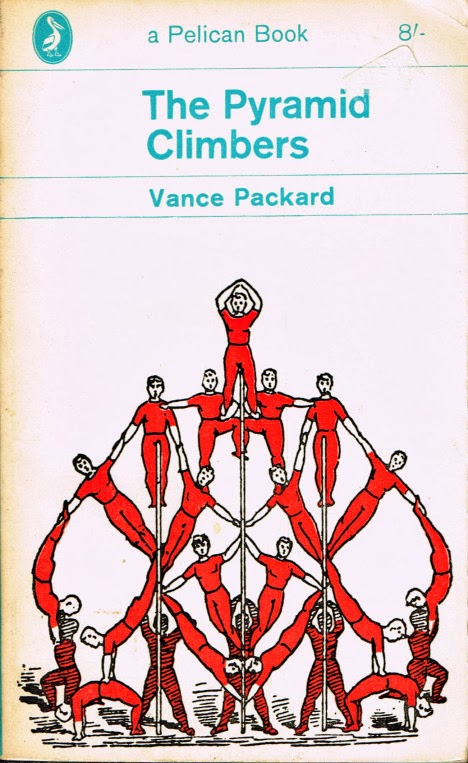
The Pyramid Climbers

Packard, Vance. 1962. The Pyramid Climbers, Penguin books. a pelican book. USA


Excerpts
PART 1 – MEN AGAINST THE MODERN PYRAMIDS
CHAPTER 1
The Bitch-Goddess Raises Her Demands

Success – ‘the bitch-goddess, Success’ in William James’s phrase – demands strange sacrifices from those who worship her. – Aldous Huxley (p13)


Despite swings in style of theoretical belief in recent decades, from fascination with ‘scientific management’ through fascination with ‘human relations’ to the most recent interest in ‘participation’, there is in actual practice today a startling amount of inhumanity in management thinking about the proper treatment of managers. Presumably this springs from management’s inherent thing-mindedness, manufacturing-mindedness, and statistics-mindedness … and from its passion for proving somehow that management is a science. At any rate, what has resulted is a proliferation of mechanistic and marketing terms to refer to managers. The good management is often a ‘smoothly running machine’. Individual managers often are reduced in management shorthand to blocks on ‘blueprints’ and become coded units in ‘management inventories’. Their salient characteristics may be punched out on IBM cards. (p 20)

A few years later, in the mid fifties, William H Whyte, Jr, described how large organizations – business, governmental, and educational – were producing a human (or unhuman) type, the ‘organization man’. In the corporations, he contented, the younger, lower-level trainees and managers were joyously embracing togetherness as a way of life. (p 22)

CHAPTER 2
The Pyramids and the Climbers

There is general agreement, however, on the three main levels of ‘management’. First there is top management, which makes policy; next, middle or administrative management, which carries out policy; and then supervisory management which has charge of the working force. (p 30)

In the competition on the pyramids it is still usually possible for two men with completely different personality patterns to be equally effective in moving towards the top – which is cheering. Consider the tow titans of the US airline business, CR Smith, president of American airlines, and WA Patterson, president of United. In the words of Fortune, ‘Smith is tall, blunt, fidgety, and capable of profane wrath; Patterson is small, tactful, relaxed, cheery.’
This possibility of radical differences in the successful personality is supported by Dr Lewis Bookwalter Ward, professor of Business Research at Harvard’s Graduate School for Business Administration. He has found that there are ‘many different ways of treating people … several styles of management’. To illustrate, he cited the cases of two plant superintendents working for a glass company. Both men were turning in top performances but went about their jobs in completely different ways. This was particularly apparent in the degree to which they inserted themselves into the activity (p 35) of their subordinates. At one man’s plant the subordinates, describing their routines, mentioned conferring with their superintendent one fifth of the time; at the other man’s plant the subordinates mentioned conferring with their superintendent on four-fifths of their activity. (p 36)


The personalities, chances, and ambitions of the competitors may differ, but the essential non-variable is the pyramid. It is always there and its climate, for better or worse, is not going to be changed in a hurry. Those climbers who hope to get near a peak are never permitted to forget the inexorable narrowing of the ledges on the ways up. With the conquest of a space on each higher ledge the rigors, tensions, and total demands increase. (p 36)

PART 2 – SCREENING, GROOMING, PRUNING
CHAPTER 3
Some Types That Seldom Survive

In projecting what management will be like in the 1980s, Harold J Leavitt, professor of industrial administration and psychology at Carnegie Tech, notes:
Apprenticeship as a basis for training managers will be used less and less, since movement up thorugh the line will become increasingly unlikely. Top management training will be taken over increasingly by the universities. (Management in the 1980s, HBR, Nov-Dec, 1958) (p 42)

CHAPTER 4
Inspecting the Serious Prospects

Ambitious men at the lower and middle ranks of management seem to be more willing to submit the fate of their careers to a psychologist’s report than are other levels of company personnel. One psychologist told me that when he was interviewing a pilot for an airline job the pilot suddenly realized his interrogator was a psychologist and called his union. The management had to instruct him to stop interviewing. Earlier, another airline almost had a stricke because pilots discovered the company was using a file of ability tests ads s convenient guide in the firing of pilots. (p 56)

Although the use of psychological tests continues to grow every year, th3re is violent disagreement among psychologists, management consultants, and company executives as to the validity and morality of their use. The outspoken Dr McMurry, after testing executives for more than two decades, now uses tests sparingly and refers to many of the testers as ‘burglars’.
Harvards’s Dr Ward concluded, after his survey of testing; ‘If it were not for the fact that so many large companies continue using tests, one would be tempted to speculate that experience in the use of psychological tests leads to their abandonment. As it is, the evidence does suggest there has been a substantial amount of negative experience on the part of some large companies who have tried testing.’ I might said that Dr ward, who helped pioneer psychological testing in the Air Force and has given tests to hundreds of executives now indicates that the feels projective-type testes are of very little use in predicting success.
In June 1961, Reed Hunt, president of Crown Zellerback Corporation, urged that all personality testing be eliminated (p 64). He explained: ‘I say this out of a certain amount of self-interest, since I understand there is not a corporation president in the country who could pass one of them or would be in his job today if he had every taken one.’
Someone should advise Mr hunt that this is scarcely an accurate or up-to-date viewpoint. In some companies today, as we have seen, even presidents (and chairmen) must submit to testing to get and hold their jobs. (p 65)

CHAPTER 5
The Wife: Distraction, Detraction, or Asset?

The marketing journal Printers’ Ink issued a special report in August 1962 which concluded: ‘Although most companies don’t publicize the extremes to which they sometimes carry wife analysis, few will consider a man for an important position without first appraising the woman behind him. At one large company, roughly 20 percent of its otherwise promotable men are passed by just because of their wives.’ (p 67)

In general, the smaller the city in which the executive works the more intensively will the wife be scrutinized. Ward Howell suggests that the candidate’s wife is likely to be an important factor in just about every US city except New York, Los Angeles, Chicago, Philadelphia, and Miami. He pointed out that the wife of a Procter & (p 68) Gamble executive in Cincinnati or a Corning Glass executive in Corning ‘has to be just about perfect.’
It is literally true – cliché or not – that in smaller cities one’s wife simply does not wear mink coat if the president’s wife does not. She does not stand up at a bar to drink, even in a sumptuous cocktail lounge. And even in the larger cities the wife still has to go to this annual party where she should prove herself to be socially gracious and well-spoken, hold her liquor, and show that she is a knowledgeable member of the team, adept at relating to her husband’s inferiors and superiors in the proper fashion. (p 69)

Four ways that a wife can be sufficiently distracting or detracting to worry the company investigators considering her husband are:
1. Will she have a negative attitude towards the commitments he must make in order to progress with the company? (p70)
2. Can the wife behave herself in a way that will not be conspicuous or jarring while in the presence of her husband’s colleagues or customers or peope in the community important to the company? (p 71)
3. Will she be a source of distracting harassment to the executive because of the kind of home life she maintains for him? (p 72)
4. Is it likely that she would fall to keep up with her husband if he begins moving ahead in the company? (p73)

All this, however, should not be taken to mean that the corporation necessarily favours the sublimely happy marriage for its men. Actually many companies appear wary of hiring a man who seems to attach too great importance to his marriage. They wonder if he is too contented to make a good competitor. And they wonder if in the clinch he would put marriage above job.
The retired head of one very large company told me that the man who goes to the top has got to be slightly dissatisfied with his marriage. The successful climber should not take the defects in his marriage so seriously that it will get in the way of his success, but he should be able to put his marriage ‘in neutral’ when his job becomes unusually demanding.
Some months ago S Vincent Wilking, vice-president of the management-consulting firm of Barrington & company, prepared a checklist for young men hoping to become top level executives. The first question was: ‘If you are under twenty-five, are you married or do you have definite plans for marriage within a year? (a) Yes, (b) No, (c) May get married, (d) I am not sure.’
The best of the first three answers would be NO. Mr Wilking explained why in these terms: ‘Early marriage suggests that family life is quite important to you; and the really successful (p 74) executive has distressingly little time for his family. If you want a full home life, you’d better be content with a lesser job.’
A senior vice-president of George Fry & associates drew up a paper entitles ‘Mr Executive – A Profile for the Sixties’ after his staff had conducted a study of case histories of executives. Here is how he sums up the marital profile of ‘Mr Executive’:
‘he enjoys a family life which is conducive to the maximum utilization of his abilities. His wife and children accept, understand, and have made good adjustment to the demands of his management responsibilities.’ (p 75)

CHAPTER 6
The Searchers and Snatchers

General Electric is one company that has recently shown a good deal of generosity in helping GE executives make connexions elsewhere, and quite possible the reasons given enhance the company’s desire to be kindly.
In many companies, however, the managements are deeply resentful when they learn that a recruiter has been trying to lure one of their good men. Howell is one of several recruiters who declared that they had been personally upbraided by company presidents enraged by their roles in luring away good men. (p 84)
The feeling is that hiring from competitors can result only in a retaliatory pirating, or in demands for higher pay from the executives who might be solicited, or in a possible loss of company know-how. Mr Howell observes: ‘When we talk to a company at the start, we ask whether we many look n the logical places for the man needed.’ (p 85)

CHAPTER 7
The Earmarking Process

Two personnel officials of General Electric detailed in the journal Personnel in 1959 how they went about conducting a manpower audit at a Cincinnati plant. They showed how they listed each man’s assets and liabilities. Under assets, for example, they listed ‘loyal to company’ and under liabilities (p 90) they mentioned ‘does not always appear to be aggressive’. The most portentous of the points to be checked, surely, was the one that invited the rater to be an oracle and predict for the man: ‘Probable higher levels to be reached’ in General Electric.
In some instances the generalized virtues used on corporate appraisal forms to assess managers seem to be copied from the report cards used to rate children at schools. The New York Times Magazine carried a repot on methods of appraisal in the late fifties which presented readers an interesting challenge. (Dale, Earnest & Alice Smith (1957) ‘Now Report Cards for Bosses’. The New York times Magazine, March 31. USA) The analysis offered portions of two report cards to the reader. One was for four-year-olds at a nursery school and the other was used by ‘one of the largest corporations in the country for grading its executives.’ The reader was challenged to guess which was which, Here they are:
REPORT CARD A
Very Satisfactory Satisfactory Unsatisfactory
Dependability
Stability
Imagination
Originality
Self-expression
Health & Vitality
Ability to plan and control
Cooperation

REPORT CARD B
Satisfactory Improving Needs Improvements
Can be depended upon
Contributes to the good work of others
Accepts and uses criticism
Thinks critically
Shows initiative
Plans work well
Physical resistance
Self-expression
Creative ability
(p 91)

The report card for executives, incidentally, was Card A. Report Card B was for the four-year-olds. (p 92)

PART 3 – THE WELL-PACKAGED EXECUTIVE

CHAPTER 8
The Executive Look

Three characteristics of top executive are: slow speech, impressive appearance, and a complete lack of sense of humour. – Johnson O’Connor, founder of the Human Engineering laboratory and the Johnson O’Connor Research Foundaton.

The impression one creates by one’s physical presence obviously is more crucial to success in some occupations than in others. It is more important to an actor, doctor, or bond sales-man than to a forest ranger, nuclear scientist, or meter-reader. The bald-headed fat man will predictably have more difficulty getting a job in a ladies’ shoe store than a men’s shoe store. (p 105)

Dr Foley : ‘In industrial psychology we have recognized for eyars thea when there is a stereotype, however fallacious, yo had better consider it if it influences success on the job.’ (p 107)

Among the facts about an executive which Hergenrather Associates believes important enough to file on the man’s IBM classification sheet are evaluations of his ‘personal appearance: face, dress, eyes’ and of his ‘poise, bearing, tact.’ Here are some of the kinds of thing that could bring a low rating:
Eyes. Are they bloodshot? Do his eyes close or roll too much when he speaks? Does he avoid looking you in the eye? Bearing. Does he flop in a chair or hand a leg over an arm of the chair? Face. Does he have lots of pimples or physical ugliness? There are managements that just won’t hire anyone who is not physically attractive, it seems, even though the person is otherwise fully qualified.. (110)

Five different informants used the work wholesome to describe the desirable executive candidate. This nice, modest, wholesome man with the fellow-next-door fact of course does not adorn that fact with a moustache, which might suggest slickness. Only 4 percent of the hundred-odd American businessmen at a Harvard course in advanced management had moustaches; none had a beard. This appropriate-looking man doesn’t smoke a pipe (which might in the mythology suggest that he was inherently lazy or too egg-heady to be a decision-0maker). He doesn’t have red hair (because everybody knows that people with red hair temperamental). (p 111)

IBM used to be notorious for its requirements about dress, especially its insistence that managers wear starched collars. Since Thomas J Watson, Jr, took over the helm from this father the situation has loosened up, but some interesting unwritten rules still apply. These were spelled out to me by to lean IBM men. Sales must wear hats (and (p 115) mechanics must wear ties). It is also still an unwritten rule that you wear a white shirt and a dark business suit (at least at headquarters).
Recently an IBM, vice-president called in a man to talk with him about the fact that he had worn a yellow shirt on the premises. Another manager got a pointed up-and-down look from the same vice-president when he came to work in a polo coat. Goatees, moustaches, and beards are not considered acceptable on an IBM man. Further, one informant remembered, ‘no one in management has overly long hair. This has to be watched.’ (p 116)

A candidate for high office in a larger organization today, however, is widely assumed to be helped if in his personal style he conveys these four impressions:
1. The impression of aplomb (p 116)
2. The impression of dignity (p 117)
3. The impression of naturalness (p 117)
4. The impression of good breeding (p 118)


CHAPTER 9
Four Rules of Behaviour for Survival

In sifting through the many ground rules –written and unwritten – that pyramid climbers frequently encounter, I find these four seem most prevalent and compelling:
RULE ONE – Be Dedicated (dead-icated?) (p 120)
RULE TWO – Be Loyal (p 122)
Loyalty is one facet of a general state of mind that is often loosely and disparagingly referred to as conformity. I don’t intend to re-argue here the whole issue of conformity in business organizations, which received a thorough airing in the fifties. However, since a number of business journals have recently proclaimed that in the sixties there is a strong swing away from conformity in corporations, we should at lest caution the ambitious young man to treat such a proclamation with extreme wariness.
Consider as evidence an October 1961 report in Nation’s Business, which is published by the Chamber of Commerce (p 122) of the United States. It described a survey made at Michigan State University. The article was titled, ‘How to Satisfy the Boss’. The MSU study explored the attitudes of sixty-four business leaders in eighteen industries on the qualities they most esteemed in subordinates.
The editors graphically summed up the findings by printing a drawing of aladder with five sturdy rungs. Each rund was labeled with one of the five qualities found in the survey to be most valued in subordinates. Here are the labels and the headline the editors printed over the ladder:
YOU’LL IMPROVE YOUR CHANCE
OF EXECUTIVE SUCCESS IF YOU:
Rescue the boss
From his own mistakes
Maintain the authoriryt
He has granted you
Be satisfied with your
Role as subordinate
Project the image of
The boss he desires
Be properly predictable
In your behaviour.

RULE THREE – Be Adaptable (p 124)
While loyalty suggests commitment, adaptability suggests adjustment. James Worthy, former vice-president at Sears, roebuck and now a management consultant, has commented: ‘Organized activity requires as a high degree of consensus, and evidence of lack of consensus is disturbing to those in positions of responsibility.’
Industrialists frequently talk wistfully about the need for men who are tigers. What they really want are cooperative tigers, tigers who come quickly to heel and can get along nicely with other tigers. They want tigers who fit in. (p 125).

RULE FOUR – Be Quietly Deferential (p 127)

Of the four rules for behaviour cited – Be Dedicated, Be Loyal, Be Adaptable, Be Quietly Deferential – the first is perhaps reasonable. At least it is relatively harmless to individual integrity. The second is valid so long as in being loyal to the company the executive can also be loyal to himself. (Assuming that he still has a self.) The last two, as commonly implements, appear to the anachronisms in a modern, enlightened society struggling to learn to live with its giant organizations. The amelioration of these rules seems to represent a substantial challenge for the future. (p 128)

CHAPTER 10
The Hazard of Mismating Man and Company

Each company has its personality, and its executive requirements vary on a number of environmental dimensions just as an industry’s does. Here are four examples of contrasting company environments:
Conscientious Vs relatively ruthless companies. (p 133)
Volume-minded Vs quality-minded companies (p 134)
Union Vs non-union companies: the vice-president of a half-billion-dollar company explained to me that if a company is non-union it needs executives who skilled at pr9moting the idea that the company is one big happy family. (p 134)
Young Vs mature companies (p 134)

Within a company, different departments may offer congenial or hostile-environment to a man – technical skills aside shows quite clearly in the study by Dr Lewis B Ward of Harvard on traits executives said they favoured in their own subordinates. (Ward, lweis B. 1961. ‘do You Want a Weak Subordinate?’ Harvard business Review. (Sept-Oct)). The executives were invited to check from a variety of clusters of four somewhat related adjectives – covering 112 qualities – those that they would favor in their subordinates. Here, side by side, are the traits favored by marketing and finance executives:
Marketing – assured, attractive, civilized, energetic, enterprising, entertaining jolly, pleasant, polished, popular, sociable, sympathetic.
Finance – accurate, ambitious, careful, cautious, deliberate, dignified, discreet, precise, systematic. (p 135)

Dr Jerome C. Beam, in his book entitled The Organization approach to decision and action (to be published by Prentice-Hall) points out six kinds of complementary matchings which improve the probability that two top-level executives will work harmoniously and effectively with each other:
1. If one man is strong, it helps if the other is supportive. (p 137)
2. If one executive is a man of action, it helps if the other is a man of thought. (p 138)
3. If one man is skilled in dealing with operations, it helps if the other is skilled in dealing with people. (p 138)
4. If one man is an excellent idea man, it helps f the other is a practical realist. (p 138)
5. If one man is a risk-taker, it helps if the other is cautious. (p 139)
6. If one man is a nice guy, it helps if the other is a tough guy. (p 139)

Dr Douglas McGregor of the Massachusetts Institute of Technology believes the difference in worlds is greater than many assume. He says: ‘The requirements for successful political leadership are different from those for industrial management or military or education leadership. Failure is as frequent as success in transfers of leaders from one type of social institution to another.’ (The Human Side of Enterprise. 1960. McGraw Hill, New York, p. 181). What it boilsdown to, evidently, is that though many of the skills required are becoming increasingly transferable, one has to work with different value systems. Furthermore, as the president of Midwestern college pointed out to me, ex34cutives in colleges and government, which are not profit-making institutions, cannot issue orders in quite the flat fashion business managers can. They must depend more upon voluntary help and the marshalling of public support. (p141)

CHAPTER 11
The Dilemma of Shifting Personality Requirements

Full Chapter p142 to p 149)


CHAPTER 15
Dead Ends and Favoured Routes

The value attached to different functions is reflected, perhaps, in surveys made of the income of college graduates a decade or so after graduation. An income survey of graduates of the Harvard Graduate School of Business Administration showed this ranking of income by fields, in descending order:
1. Finance
2. Marketing
3. Production and operations
4. Research and development and other technical functions
5. General administration
6. Accounting
7. Personnel and labour relations
(p 202)

CHAPTER 17
The Problem of Being the Right Age

Most of the serious candidates for corporate presidencies in the US today are in their early fifties. They will, on the average, be tapped by the age of fifty-five. In Great Britain they are tapped somewhat earlier.
US corporate leaders may conceivably be influenced to name more younger men as presidents by the example of a man in his early forties taking over the presidency of the US, although some corporate elders view the ensuing developments in Washington as good reason for their wariness of upstarts in high office. (p 222)

A good example of a movable man was Cramer W la Pierre, who grew up a General Electric and at the age of forty-three found himself in a spot where the layers directly above him were filled by men from his own age group. He was then reportedly making between $10,000 and $15,000. So he decided to accept a vice-presidency at the much smaller American machine & Foundry (at more than double his GE salary) where he filled the position with distinction. Three years later the GE management, looking over its outstanding alumni for a possible vice-president, hired him back. In 1961 he was given a newly created job of executive vice-president at a total compensation that may well exceed $150,000. Recruiter John Handy feels that quite probably he would not have got past all those layers if he had not got out and made the end run. (p 223)

A good deal of thought has been given to assessing what Mr handy calls the ‘Age-Position Relationship’ as one variable factor in establishing a man’s potential. Where should the man be on the success scale at each age level and what should he be doing about his career? (p 226)


CHAPTER 19
The Worst Kind of Places

A number of the GE executives indicated that it was painfully plain to them that if they wanted to get ahead in the company they would have to cooperate in the price fixing. It was called ‘a way of life’. The marketing manager of the switchgear division, a man named Walter F Rauber, was replaced after he refused to violate the 20.5 directive he had signed. (p 248)

CHAPTER 20
Private Strains: The Executive as Lover, Father, Neighbour

Perhaps the first thing to be noted about the rising executive’s private life is that he is a man in motion. His motion upwards in the company’s hierarchy usually causes him- whether he likes it or not – to leave old houses, old neighbourhoods, and old friends behind. (p 249)

A manager who is rising in the company hierarchy is often expected to break clean all his socializing contacts with families he has left behind. The most explicit statement f this expectation – at least for lower-level managers – appeared in an article entitled ‘the Office Caste System’ which was first printed in Modern Office Procedures and was reprinted in the American management Association’s Manage (p 258) ment Review (July 1960). One question centred on what a supervisor should do about his old friendships when promoted to a level above his old friends. Thjs article reports: ‘His question gets a brief, sharp answer form the personnel director of a large company: “Cut’em off. If a man cherishes his old friendship, he’d better not take the promotion.” Most companies agree it’s best to amputate.’
At a later point the article conceded that such amputation was harde3r on the wife than ton the supervisor. It quoted one supervisor who confessed he had had a fight with his wife because he suggested she had better drop out of her bridge club with seven wives of men from her husband’s former level in the hierarchy. The article commented: ‘Unfortunately, companies don’t agree with her. One executive speaks for many companies when he says, “The wife has no choice. She can be downright dangerous if she insists on keeping close friendships with the wives of her husband’s subordinates”.’ The article indicated that children also are affected by an unstated need to avoid children of people their father has surpassed. (p 259).

All his years of conferring with executives and their wives have led him to this irreverent conclusion: ‘Executives may be at the top of the ladder vocationally but they are at the foot when it comes to making love.’ (p 263)


CHAPTER 21
When Stress Becomes Distress

Some interesting patterns in a9ilmens afflicting executives emerge. A Chicago executive health clinic found, after making what the American Medical Association called ‘one of the most exhaustive surveys of executive health ever completed’, that men and women in high-level jobs suffer less from (p 264) deficiency diseases than American generally, but tend to suffer much more from metabolic disorders. These include high cholesterol and low rate of thyroid secretion. (p 265)
Dr Robert Felix, director of the National Institute of Mental Health, has suggested that there are three ways in which businessmen react unhealthily to stress: by disorders of bodily functions, by disorders of thought, and by disorders of behaviour. (‘How to live with Job Pressure’, nation’s Business, Sept 1956) (p 267).

CHAPTER 23
Some Large Questions About Executive Assessment Techniques

Among companies, General Electric is one of the several major institutions whose current managements are having grave second thoughts about the value of the assembly-line approach to ‘developing’ executives through rotating, teaching, periodic checking of personality traits, and similar routines. When GE invited outside interviewers to ask 300 top managers what had been most important to their development, 90% said: ‘It was working for So-and-so at such-and-such a place’ – some inspiring mentor in an exciting environment. GE’s Moorhead Wright has decided that ‘rating sheets based on personality traits generally fail in actual application. Time and again men who rate poorly turn out to be good managers, and vice versa. Even such a faithful standby as education is a poor measurement.’
Another popular concept that GE has rejected is the practice of singling out the promising men early and giving them an exclusive change to travel the road to the top. Out of curiosity its officials checked up on 143 men who had been singled out for special grooming then years earlier, Only a little more than a third of them were fulfilling their early promise. (p 283)

Dr Likert feels strongly that if a company is to get the best performance out of a man, his superior must play a supportive role, which contributes for the subordinate’s sense of personal worth and importance. (p 285)

CHAPTER 25
Experiments in Rediscovering the Individual

Some observers have called for an all-out fight against the organization as the only hope of salvaging the individual. Others argue that, realistically, the greater hope lies in trying to increase the potential for individual growth within a framework of cooperative effort in the organization. Douglas McGregor, Chris Argyris, and Hary Levinson are three who have come to this viewpoint. In fact, Professor McGregor contends that a really effective managerial group ‘provides the best possible environment for individual development.’ And Dr Argyris believes that the conflict between the individual and the formal organization, though it usually leads to decay in the individual, can in fact be a source for growth.
What can be done to increase the individual human’s potential for growth and personal fulfillment in large organizations? Dr Levinson suggests that, as a very minimum to assure sound mental health, and jobholder anywhere should be able to find in his work:
A sense of shaping his own life activities.
A sense of participation with dignity in both the task and the decisions which affect him relating to it.
A sense of status, worthwhileness, recognition.
A sense of creative contribution – of giving something of himself for the betterment of his fellows.

If the human potential is to be optimized in large business organizations it is obvious that their managements must build in mechanisms for the expression of dissent and criticism. Free society at large has such means for an honest voicing of dissent without fear of penalty, but most of the billion-dollar private bureaucracies do not. Individuals within these organizations must usually be content to hear critical thoughts about corporate practices only in the washrooms and read them in such journals as Fortune and the Harvard Business Review. Some of the recent excesses in trait-rating, (p 303) for example, surely would have been avoided if managers had had an honestly open forum.
Cornell economist Ernest Dale contends that ‘the greatest single bane of management today is its growing absolutism, its refusal to discuss or listen to different opinions, Management must encourage free discussion’ in its own ranks. Dr Argyris suggests that the manager needs to have opportunities to question the very “guts” of the company’s makeup.’ (p 304)

Dr Argyris feels that the power pyramid is inefficient from management’s standpoint because it can’t solve problems in such a way that they stay solved. On the pyramid, feelings tend to get suppressed so that there is a loss of openness and authentic relationships. No one is willing to upset the top authorities by giving them unpleasant facts. There is the constant tendency to keep one’s head down a reluctance to experiment, take risks. After observing executives in action on hundreds of occasions Argyris has concluded that such factors lead to less effective decision-making, deeper organization ‘increasing inputs of human energy to achieve its objective, maintain itself internally, and adapt to its external environment.’ (Chris Argyris, Interpersonal Competence and Organizational Effectiveness, Tavistock Publications, 1962, p 131) (p 308)

--------
this is a great book on organising, academic content with practical aspects.....

AATMANIRBHAR: by Ashwani Mahajan (editor)

AATMANIRBHAR: a swadeshi paradigm (2023) by ASHWANI MAHAJAN (editor), Rupa Publications, New Delhi, p 226 The prerequisite for visioning Ind...