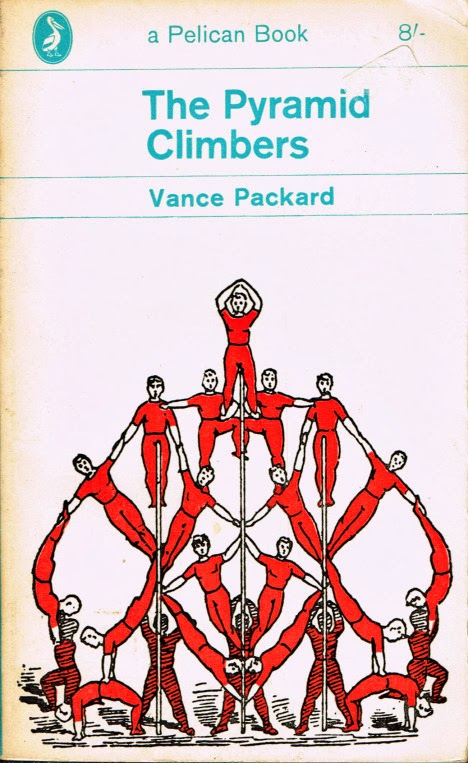
Packard, Vance. 1962. The Pyramid Climbers, Penguin books. a pelican book. USA
Excerpts
PART 1 – MEN AGAINST THE MODERN PYRAMIDS
CHAPTER 1
The Bitch-Goddess Raises Her Demands
Success – ‘the bitch-goddess, Success’ in William James’s phrase – demands strange sacrifices from those who worship her. – Aldous Huxley (p13)
Despite swings in style of theoretical belief in recent decades, from fascination with ‘scientific management’ through fascination with ‘human relations’ to the most recent interest in ‘participation’, there is in actual practice today a startling amount of inhumanity in management thinking about the proper treatment of managers. Presumably this springs from management’s inherent thing-mindedness, manufacturing-mindedness, and statistics-mindedness … and from its passion for proving somehow that management is a science. At any rate, what has resulted is a proliferation of mechanistic and marketing terms to refer to managers. The good management is often a ‘smoothly running machine’. Individual managers often are reduced in management shorthand to blocks on ‘blueprints’ and become coded units in ‘management inventories’. Their salient characteristics may be punched out on IBM cards. (p 20)
A few years later, in the mid fifties, William H Whyte, Jr, described how large organizations – business, governmental, and educational – were producing a human (or unhuman) type, the ‘organization man’. In the corporations, he contented, the younger, lower-level trainees and managers were joyously embracing togetherness as a way of life. (p 22)
CHAPTER 2
The Pyramids and the Climbers
There is general agreement, however, on the three main levels of ‘management’. First there is top management, which makes policy; next, middle or administrative management, which carries out policy; and then supervisory management which has charge of the working force. (p 30)
In the competition on the pyramids it is still usually possible for two men with completely different personality patterns to be equally effective in moving towards the top – which is cheering. Consider the tow titans of the US airline business, CR Smith, president of American airlines, and WA Patterson, president of United. In the words of Fortune, ‘Smith is tall, blunt, fidgety, and capable of profane wrath; Patterson is small, tactful, relaxed, cheery.’
This possibility of radical differences in the successful personality is supported by Dr Lewis Bookwalter Ward, professor of Business Research at Harvard’s Graduate School for Business Administration. He has found that there are ‘many different ways of treating people … several styles of management’. To illustrate, he cited the cases of two plant superintendents working for a glass company. Both men were turning in top performances but went about their jobs in completely different ways. This was particularly apparent in the degree to which they inserted themselves into the activity (p 35) of their subordinates. At one man’s plant the subordinates, describing their routines, mentioned conferring with their superintendent one fifth of the time; at the other man’s plant the subordinates mentioned conferring with their superintendent on four-fifths of their activity. (p 36)
The personalities, chances, and ambitions of the competitors may differ, but the essential non-variable is the pyramid. It is always there and its climate, for better or worse, is not going to be changed in a hurry. Those climbers who hope to get near a peak are never permitted to forget the inexorable narrowing of the ledges on the ways up. With the conquest of a space on each higher ledge the rigors, tensions, and total demands increase. (p 36)
PART 2 – SCREENING, GROOMING, PRUNING
CHAPTER 3
Some Types That Seldom Survive
In projecting what management will be like in the 1980s, Harold J Leavitt, professor of industrial administration and psychology at Carnegie Tech, notes:
Apprenticeship as a basis for training managers will be used less and less, since movement up thorugh the line will become increasingly unlikely. Top management training will be taken over increasingly by the universities. (Management in the 1980s, HBR, Nov-Dec, 1958) (p 42)
CHAPTER 4
Inspecting the Serious Prospects
Ambitious men at the lower and middle ranks of management seem to be more willing to submit the fate of their careers to a psychologist’s report than are other levels of company personnel. One psychologist told me that when he was interviewing a pilot for an airline job the pilot suddenly realized his interrogator was a psychologist and called his union. The management had to instruct him to stop interviewing. Earlier, another airline almost had a stricke because pilots discovered the company was using a file of ability tests ads s convenient guide in the firing of pilots. (p 56)
Although the use of psychological tests continues to grow every year, th3re is violent disagreement among psychologists, management consultants, and company executives as to the validity and morality of their use. The outspoken Dr McMurry, after testing executives for more than two decades, now uses tests sparingly and refers to many of the testers as ‘burglars’.
Harvards’s Dr Ward concluded, after his survey of testing; ‘If it were not for the fact that so many large companies continue using tests, one would be tempted to speculate that experience in the use of psychological tests leads to their abandonment. As it is, the evidence does suggest there has been a substantial amount of negative experience on the part of some large companies who have tried testing.’ I might said that Dr ward, who helped pioneer psychological testing in the Air Force and has given tests to hundreds of executives now indicates that the feels projective-type testes are of very little use in predicting success.
In June 1961, Reed Hunt, president of Crown Zellerback Corporation, urged that all personality testing be eliminated (p 64). He explained: ‘I say this out of a certain amount of self-interest, since I understand there is not a corporation president in the country who could pass one of them or would be in his job today if he had every taken one.’
Someone should advise Mr hunt that this is scarcely an accurate or up-to-date viewpoint. In some companies today, as we have seen, even presidents (and chairmen) must submit to testing to get and hold their jobs. (p 65)
CHAPTER 5
The Wife: Distraction, Detraction, or Asset?
The marketing journal Printers’ Ink issued a special report in August 1962 which concluded: ‘Although most companies don’t publicize the extremes to which they sometimes carry wife analysis, few will consider a man for an important position without first appraising the woman behind him. At one large company, roughly 20 percent of its otherwise promotable men are passed by just because of their wives.’ (p 67)
In general, the smaller the city in which the executive works the more intensively will the wife be scrutinized. Ward Howell suggests that the candidate’s wife is likely to be an important factor in just about every US city except New York, Los Angeles, Chicago, Philadelphia, and Miami. He pointed out that the wife of a Procter & (p 68) Gamble executive in Cincinnati or a Corning Glass executive in Corning ‘has to be just about perfect.’
It is literally true – cliché or not – that in smaller cities one’s wife simply does not wear mink coat if the president’s wife does not. She does not stand up at a bar to drink, even in a sumptuous cocktail lounge. And even in the larger cities the wife still has to go to this annual party where she should prove herself to be socially gracious and well-spoken, hold her liquor, and show that she is a knowledgeable member of the team, adept at relating to her husband’s inferiors and superiors in the proper fashion. (p 69)
Four ways that a wife can be sufficiently distracting or detracting to worry the company investigators considering her husband are:
1. Will she have a negative attitude towards the commitments he must make in order to progress with the company? (p70)
2. Can the wife behave herself in a way that will not be conspicuous or jarring while in the presence of her husband’s colleagues or customers or peope in the community important to the company? (p 71)
3. Will she be a source of distracting harassment to the executive because of the kind of home life she maintains for him? (p 72)
4. Is it likely that she would fall to keep up with her husband if he begins moving ahead in the company? (p73)
All this, however, should not be taken to mean that the corporation necessarily favours the sublimely happy marriage for its men. Actually many companies appear wary of hiring a man who seems to attach too great importance to his marriage. They wonder if he is too contented to make a good competitor. And they wonder if in the clinch he would put marriage above job.
The retired head of one very large company told me that the man who goes to the top has got to be slightly dissatisfied with his marriage. The successful climber should not take the defects in his marriage so seriously that it will get in the way of his success, but he should be able to put his marriage ‘in neutral’ when his job becomes unusually demanding.
Some months ago S Vincent Wilking, vice-president of the management-consulting firm of Barrington & company, prepared a checklist for young men hoping to become top level executives. The first question was: ‘If you are under twenty-five, are you married or do you have definite plans for marriage within a year? (a) Yes, (b) No, (c) May get married, (d) I am not sure.’
The best of the first three answers would be NO. Mr Wilking explained why in these terms: ‘Early marriage suggests that family life is quite important to you; and the really successful (p 74) executive has distressingly little time for his family. If you want a full home life, you’d better be content with a lesser job.’
A senior vice-president of George Fry & associates drew up a paper entitles ‘Mr Executive – A Profile for the Sixties’ after his staff had conducted a study of case histories of executives. Here is how he sums up the marital profile of ‘Mr Executive’:
‘he enjoys a family life which is conducive to the maximum utilization of his abilities. His wife and children accept, understand, and have made good adjustment to the demands of his management responsibilities.’ (p 75)
CHAPTER 6
The Searchers and Snatchers
General Electric is one company that has recently shown a good deal of generosity in helping GE executives make connexions elsewhere, and quite possible the reasons given enhance the company’s desire to be kindly.
In many companies, however, the managements are deeply resentful when they learn that a recruiter has been trying to lure one of their good men. Howell is one of several recruiters who declared that they had been personally upbraided by company presidents enraged by their roles in luring away good men. (p 84)
The feeling is that hiring from competitors can result only in a retaliatory pirating, or in demands for higher pay from the executives who might be solicited, or in a possible loss of company know-how. Mr Howell observes: ‘When we talk to a company at the start, we ask whether we many look n the logical places for the man needed.’ (p 85)
CHAPTER 7
The Earmarking Process
Two personnel officials of General Electric detailed in the journal Personnel in 1959 how they went about conducting a manpower audit at a Cincinnati plant. They showed how they listed each man’s assets and liabilities. Under assets, for example, they listed ‘loyal to company’ and under liabilities (p 90) they mentioned ‘does not always appear to be aggressive’. The most portentous of the points to be checked, surely, was the one that invited the rater to be an oracle and predict for the man: ‘Probable higher levels to be reached’ in General Electric.
In some instances the generalized virtues used on corporate appraisal forms to assess managers seem to be copied from the report cards used to rate children at schools. The New York Times Magazine carried a repot on methods of appraisal in the late fifties which presented readers an interesting challenge. (Dale, Earnest & Alice Smith (1957) ‘Now Report Cards for Bosses’. The New York times Magazine, March 31. USA) The analysis offered portions of two report cards to the reader. One was for four-year-olds at a nursery school and the other was used by ‘one of the largest corporations in the country for grading its executives.’ The reader was challenged to guess which was which, Here they are:
REPORT CARD A
Very Satisfactory Satisfactory Unsatisfactory
Dependability
Stability
Imagination
Originality
Self-expression
Health & Vitality
Ability to plan and control
Cooperation
REPORT CARD B
Satisfactory Improving Needs Improvements
Can be depended upon
Contributes to the good work of others
Accepts and uses criticism
Thinks critically
Shows initiative
Plans work well
Physical resistance
Self-expression
Creative ability
(p 91)
The report card for executives, incidentally, was Card A. Report Card B was for the four-year-olds. (p 92)
PART 3 – THE WELL-PACKAGED EXECUTIVE
CHAPTER 8
The Executive Look
Three characteristics of top executive are: slow speech, impressive appearance, and a complete lack of sense of humour. – Johnson O’Connor, founder of the Human Engineering laboratory and the Johnson O’Connor Research Foundaton.
The impression one creates by one’s physical presence obviously is more crucial to success in some occupations than in others. It is more important to an actor, doctor, or bond sales-man than to a forest ranger, nuclear scientist, or meter-reader. The bald-headed fat man will predictably have more difficulty getting a job in a ladies’ shoe store than a men’s shoe store. (p 105)
Dr Foley : ‘In industrial psychology we have recognized for eyars thea when there is a stereotype, however fallacious, yo had better consider it if it influences success on the job.’ (p 107)
Among the facts about an executive which Hergenrather Associates believes important enough to file on the man’s IBM classification sheet are evaluations of his ‘personal appearance: face, dress, eyes’ and of his ‘poise, bearing, tact.’ Here are some of the kinds of thing that could bring a low rating:
Eyes. Are they bloodshot? Do his eyes close or roll too much when he speaks? Does he avoid looking you in the eye? Bearing. Does he flop in a chair or hand a leg over an arm of the chair? Face. Does he have lots of pimples or physical ugliness? There are managements that just won’t hire anyone who is not physically attractive, it seems, even though the person is otherwise fully qualified.. (110)
Five different informants used the work wholesome to describe the desirable executive candidate. This nice, modest, wholesome man with the fellow-next-door fact of course does not adorn that fact with a moustache, which might suggest slickness. Only 4 percent of the hundred-odd American businessmen at a Harvard course in advanced management had moustaches; none had a beard. This appropriate-looking man doesn’t smoke a pipe (which might in the mythology suggest that he was inherently lazy or too egg-heady to be a decision-0maker). He doesn’t have red hair (because everybody knows that people with red hair temperamental). (p 111)
IBM used to be notorious for its requirements about dress, especially its insistence that managers wear starched collars. Since Thomas J Watson, Jr, took over the helm from this father the situation has loosened up, but some interesting unwritten rules still apply. These were spelled out to me by to lean IBM men. Sales must wear hats (and (p 115) mechanics must wear ties). It is also still an unwritten rule that you wear a white shirt and a dark business suit (at least at headquarters).
Recently an IBM, vice-president called in a man to talk with him about the fact that he had worn a yellow shirt on the premises. Another manager got a pointed up-and-down look from the same vice-president when he came to work in a polo coat. Goatees, moustaches, and beards are not considered acceptable on an IBM man. Further, one informant remembered, ‘no one in management has overly long hair. This has to be watched.’ (p 116)
A candidate for high office in a larger organization today, however, is widely assumed to be helped if in his personal style he conveys these four impressions:
1. The impression of aplomb (p 116)
2. The impression of dignity (p 117)
3. The impression of naturalness (p 117)
4. The impression of good breeding (p 118)
CHAPTER 9
Four Rules of Behaviour for Survival
In sifting through the many ground rules –written and unwritten – that pyramid climbers frequently encounter, I find these four seem most prevalent and compelling:
RULE ONE – Be Dedicated (dead-icated?) (p 120)
RULE TWO – Be Loyal (p 122)
Loyalty is one facet of a general state of mind that is often loosely and disparagingly referred to as conformity. I don’t intend to re-argue here the whole issue of conformity in business organizations, which received a thorough airing in the fifties. However, since a number of business journals have recently proclaimed that in the sixties there is a strong swing away from conformity in corporations, we should at lest caution the ambitious young man to treat such a proclamation with extreme wariness.
Consider as evidence an October 1961 report in Nation’s Business, which is published by the Chamber of Commerce (p 122) of the United States. It described a survey made at Michigan State University. The article was titled, ‘How to Satisfy the Boss’. The MSU study explored the attitudes of sixty-four business leaders in eighteen industries on the qualities they most esteemed in subordinates.
The editors graphically summed up the findings by printing a drawing of aladder with five sturdy rungs. Each rund was labeled with one of the five qualities found in the survey to be most valued in subordinates. Here are the labels and the headline the editors printed over the ladder:
YOU’LL IMPROVE YOUR CHANCE
OF EXECUTIVE SUCCESS IF YOU:
Rescue the boss
From his own mistakes
Maintain the authoriryt
He has granted you
Be satisfied with your
Role as subordinate
Project the image of
The boss he desires
Be properly predictable
In your behaviour.
RULE THREE – Be Adaptable (p 124)
While loyalty suggests commitment, adaptability suggests adjustment. James Worthy, former vice-president at Sears, roebuck and now a management consultant, has commented: ‘Organized activity requires as a high degree of consensus, and evidence of lack of consensus is disturbing to those in positions of responsibility.’
Industrialists frequently talk wistfully about the need for men who are tigers. What they really want are cooperative tigers, tigers who come quickly to heel and can get along nicely with other tigers. They want tigers who fit in. (p 125).
RULE FOUR – Be Quietly Deferential (p 127)
Of the four rules for behaviour cited – Be Dedicated, Be Loyal, Be Adaptable, Be Quietly Deferential – the first is perhaps reasonable. At least it is relatively harmless to individual integrity. The second is valid so long as in being loyal to the company the executive can also be loyal to himself. (Assuming that he still has a self.) The last two, as commonly implements, appear to the anachronisms in a modern, enlightened society struggling to learn to live with its giant organizations. The amelioration of these rules seems to represent a substantial challenge for the future. (p 128)
CHAPTER 10
The Hazard of Mismating Man and Company
Each company has its personality, and its executive requirements vary on a number of environmental dimensions just as an industry’s does. Here are four examples of contrasting company environments:
Conscientious Vs relatively ruthless companies. (p 133)
Volume-minded Vs quality-minded companies (p 134)
Union Vs non-union companies: the vice-president of a half-billion-dollar company explained to me that if a company is non-union it needs executives who skilled at pr9moting the idea that the company is one big happy family. (p 134)
Young Vs mature companies (p 134)
Within a company, different departments may offer congenial or hostile-environment to a man – technical skills aside shows quite clearly in the study by Dr Lewis B Ward of Harvard on traits executives said they favoured in their own subordinates. (Ward, lweis B. 1961. ‘do You Want a Weak Subordinate?’ Harvard business Review. (Sept-Oct)). The executives were invited to check from a variety of clusters of four somewhat related adjectives – covering 112 qualities – those that they would favor in their subordinates. Here, side by side, are the traits favored by marketing and finance executives:
Marketing – assured, attractive, civilized, energetic, enterprising, entertaining jolly, pleasant, polished, popular, sociable, sympathetic.
Finance – accurate, ambitious, careful, cautious, deliberate, dignified, discreet, precise, systematic. (p 135)
Dr Jerome C. Beam, in his book entitled The Organization approach to decision and action (to be published by Prentice-Hall) points out six kinds of complementary matchings which improve the probability that two top-level executives will work harmoniously and effectively with each other:
1. If one man is strong, it helps if the other is supportive. (p 137)
2. If one executive is a man of action, it helps if the other is a man of thought. (p 138)
3. If one man is skilled in dealing with operations, it helps if the other is skilled in dealing with people. (p 138)
4. If one man is an excellent idea man, it helps f the other is a practical realist. (p 138)
5. If one man is a risk-taker, it helps if the other is cautious. (p 139)
6. If one man is a nice guy, it helps if the other is a tough guy. (p 139)
Dr Douglas McGregor of the Massachusetts Institute of Technology believes the difference in worlds is greater than many assume. He says: ‘The requirements for successful political leadership are different from those for industrial management or military or education leadership. Failure is as frequent as success in transfers of leaders from one type of social institution to another.’ (The Human Side of Enterprise. 1960. McGraw Hill, New York, p. 181). What it boilsdown to, evidently, is that though many of the skills required are becoming increasingly transferable, one has to work with different value systems. Furthermore, as the president of Midwestern college pointed out to me, ex34cutives in colleges and government, which are not profit-making institutions, cannot issue orders in quite the flat fashion business managers can. They must depend more upon voluntary help and the marshalling of public support. (p141)
CHAPTER 11
The Dilemma of Shifting Personality Requirements
Full Chapter p142 to p 149)
CHAPTER 15
Dead Ends and Favoured Routes
The value attached to different functions is reflected, perhaps, in surveys made of the income of college graduates a decade or so after graduation. An income survey of graduates of the Harvard Graduate School of Business Administration showed this ranking of income by fields, in descending order:
1. Finance
2. Marketing
3. Production and operations
4. Research and development and other technical functions
5. General administration
6. Accounting
7. Personnel and labour relations
(p 202)
CHAPTER 17
The Problem of Being the Right Age
Most of the serious candidates for corporate presidencies in the US today are in their early fifties. They will, on the average, be tapped by the age of fifty-five. In Great Britain they are tapped somewhat earlier.
US corporate leaders may conceivably be influenced to name more younger men as presidents by the example of a man in his early forties taking over the presidency of the US, although some corporate elders view the ensuing developments in Washington as good reason for their wariness of upstarts in high office. (p 222)
A good example of a movable man was Cramer W la Pierre, who grew up a General Electric and at the age of forty-three found himself in a spot where the layers directly above him were filled by men from his own age group. He was then reportedly making between $10,000 and $15,000. So he decided to accept a vice-presidency at the much smaller American machine & Foundry (at more than double his GE salary) where he filled the position with distinction. Three years later the GE management, looking over its outstanding alumni for a possible vice-president, hired him back. In 1961 he was given a newly created job of executive vice-president at a total compensation that may well exceed $150,000. Recruiter John Handy feels that quite probably he would not have got past all those layers if he had not got out and made the end run. (p 223)
A good deal of thought has been given to assessing what Mr handy calls the ‘Age-Position Relationship’ as one variable factor in establishing a man’s potential. Where should the man be on the success scale at each age level and what should he be doing about his career? (p 226)
CHAPTER 19
The Worst Kind of Places
A number of the GE executives indicated that it was painfully plain to them that if they wanted to get ahead in the company they would have to cooperate in the price fixing. It was called ‘a way of life’. The marketing manager of the switchgear division, a man named Walter F Rauber, was replaced after he refused to violate the 20.5 directive he had signed. (p 248)
CHAPTER 20
Private Strains: The Executive as Lover, Father, Neighbour
Perhaps the first thing to be noted about the rising executive’s private life is that he is a man in motion. His motion upwards in the company’s hierarchy usually causes him- whether he likes it or not – to leave old houses, old neighbourhoods, and old friends behind. (p 249)
A manager who is rising in the company hierarchy is often expected to break clean all his socializing contacts with families he has left behind. The most explicit statement f this expectation – at least for lower-level managers – appeared in an article entitled ‘the Office Caste System’ which was first printed in Modern Office Procedures and was reprinted in the American management Association’s Manage (p 258) ment Review (July 1960). One question centred on what a supervisor should do about his old friendships when promoted to a level above his old friends. Thjs article reports: ‘His question gets a brief, sharp answer form the personnel director of a large company: “Cut’em off. If a man cherishes his old friendship, he’d better not take the promotion.” Most companies agree it’s best to amputate.’
At a later point the article conceded that such amputation was harde3r on the wife than ton the supervisor. It quoted one supervisor who confessed he had had a fight with his wife because he suggested she had better drop out of her bridge club with seven wives of men from her husband’s former level in the hierarchy. The article commented: ‘Unfortunately, companies don’t agree with her. One executive speaks for many companies when he says, “The wife has no choice. She can be downright dangerous if she insists on keeping close friendships with the wives of her husband’s subordinates”.’ The article indicated that children also are affected by an unstated need to avoid children of people their father has surpassed. (p 259).
All his years of conferring with executives and their wives have led him to this irreverent conclusion: ‘Executives may be at the top of the ladder vocationally but they are at the foot when it comes to making love.’ (p 263)
CHAPTER 21
When Stress Becomes Distress
Some interesting patterns in a9ilmens afflicting executives emerge. A Chicago executive health clinic found, after making what the American Medical Association called ‘one of the most exhaustive surveys of executive health ever completed’, that men and women in high-level jobs suffer less from (p 264) deficiency diseases than American generally, but tend to suffer much more from metabolic disorders. These include high cholesterol and low rate of thyroid secretion. (p 265)
Dr Robert Felix, director of the National Institute of Mental Health, has suggested that there are three ways in which businessmen react unhealthily to stress: by disorders of bodily functions, by disorders of thought, and by disorders of behaviour. (‘How to live with Job Pressure’, nation’s Business, Sept 1956) (p 267).
CHAPTER 23
Some Large Questions About Executive Assessment Techniques
Among companies, General Electric is one of the several major institutions whose current managements are having grave second thoughts about the value of the assembly-line approach to ‘developing’ executives through rotating, teaching, periodic checking of personality traits, and similar routines. When GE invited outside interviewers to ask 300 top managers what had been most important to their development, 90% said: ‘It was working for So-and-so at such-and-such a place’ – some inspiring mentor in an exciting environment. GE’s Moorhead Wright has decided that ‘rating sheets based on personality traits generally fail in actual application. Time and again men who rate poorly turn out to be good managers, and vice versa. Even such a faithful standby as education is a poor measurement.’
Another popular concept that GE has rejected is the practice of singling out the promising men early and giving them an exclusive change to travel the road to the top. Out of curiosity its officials checked up on 143 men who had been singled out for special grooming then years earlier, Only a little more than a third of them were fulfilling their early promise. (p 283)
Dr Likert feels strongly that if a company is to get the best performance out of a man, his superior must play a supportive role, which contributes for the subordinate’s sense of personal worth and importance. (p 285)
CHAPTER 25
Experiments in Rediscovering the Individual
Some observers have called for an all-out fight against the organization as the only hope of salvaging the individual. Others argue that, realistically, the greater hope lies in trying to increase the potential for individual growth within a framework of cooperative effort in the organization. Douglas McGregor, Chris Argyris, and Hary Levinson are three who have come to this viewpoint. In fact, Professor McGregor contends that a really effective managerial group ‘provides the best possible environment for individual development.’ And Dr Argyris believes that the conflict between the individual and the formal organization, though it usually leads to decay in the individual, can in fact be a source for growth.
What can be done to increase the individual human’s potential for growth and personal fulfillment in large organizations? Dr Levinson suggests that, as a very minimum to assure sound mental health, and jobholder anywhere should be able to find in his work:
A sense of shaping his own life activities.
A sense of participation with dignity in both the task and the decisions which affect him relating to it.
A sense of status, worthwhileness, recognition.
A sense of creative contribution – of giving something of himself for the betterment of his fellows.
If the human potential is to be optimized in large business organizations it is obvious that their managements must build in mechanisms for the expression of dissent and criticism. Free society at large has such means for an honest voicing of dissent without fear of penalty, but most of the billion-dollar private bureaucracies do not. Individuals within these organizations must usually be content to hear critical thoughts about corporate practices only in the washrooms and read them in such journals as Fortune and the Harvard Business Review. Some of the recent excesses in trait-rating, (p 303) for example, surely would have been avoided if managers had had an honestly open forum.
Cornell economist Ernest Dale contends that ‘the greatest single bane of management today is its growing absolutism, its refusal to discuss or listen to different opinions, Management must encourage free discussion’ in its own ranks. Dr Argyris suggests that the manager needs to have opportunities to question the very “guts” of the company’s makeup.’ (p 304)
Dr Argyris feels that the power pyramid is inefficient from management’s standpoint because it can’t solve problems in such a way that they stay solved. On the pyramid, feelings tend to get suppressed so that there is a loss of openness and authentic relationships. No one is willing to upset the top authorities by giving them unpleasant facts. There is the constant tendency to keep one’s head down a reluctance to experiment, take risks. After observing executives in action on hundreds of occasions Argyris has concluded that such factors lead to less effective decision-making, deeper organization ‘increasing inputs of human energy to achieve its objective, maintain itself internally, and adapt to its external environment.’ (Chris Argyris, Interpersonal Competence and Organizational Effectiveness, Tavistock Publications, 1962, p 131) (p 308)
--------
this is a great book on organising, academic content with practical aspects.....